
Congratulations on Your Perfect Resume. Now Let's Talk About Your Actual Career.
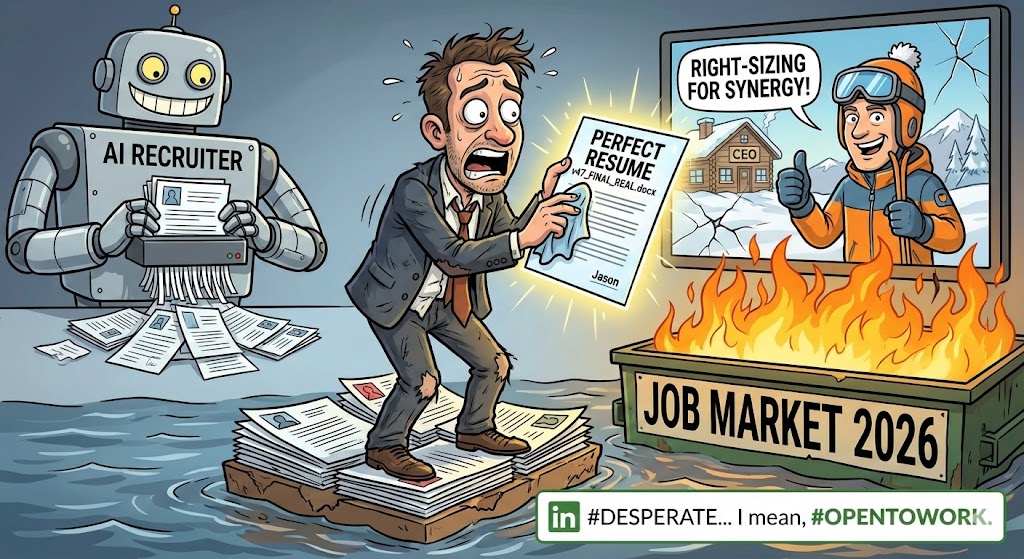
Why fixing your font size won’t save you from the Algorithm, and why you need a GPS, not a prayer. Try CareerPlot if you haven’t.
Part I: The Funeral of a Job Title
Let’s start with a scene you probably know too well. Let’s talk about Jason.
Jason is a Product Lead at a mid-sized tech company. For six months, Jason has been feeling uneasy. But he pushes it down with the help of too much coffee, a false sense of security, and the comforting glow of his dual monitors.
Last Tuesday, at 9:00 AM sharp, Jason joined a mandatory all-hands video call. The CEO was calling in from what looked suspiciously like a ski lodge in Aspen, wearing a turtleneck that cost more than Jason’s car. He spoke somberly about “macroeconomic headwinds” and “right-sizing the ship to optimize operational synergy.” Jason zoned out because he was too busy messaging his work bestie, Sarah, making a joke about how the CEO looked like a Bond villain who just bought a Peloton.
By 9:04 AM, Jason’s screen went black. His Slack access was gone. His email was locked. His job title evaporated into thin air. He was part of the 12% workforce reduction.
By 9:30 AM, Jason was panicking. By 10:00 AM, he was in the Denial Phase. And by 10:15 AM, he was doing what every desperate professional does when their career implodes. He opened a Word document.
For the last three weekends, Jason has treated his resume like it is a sacred text. He has polished it like a diamond. He agonized over whether “spearheaded” sounds more authoritative than “led.” He sprinkled in corporate words like “cross-functional collaboration” and “dynamic innovator” as if they were magic spells meant to exorcise the demon of unemployment.
He wrote a stunning piece of corporate fan fiction starring himself as the hero. He hit the Easy Apply button on two hundred jobs on LinkedIn. Then he sat back, staring at his inbox, waiting for the gods of recruiting to descend from the clouds and crown him the Chosen One.
And what did he get?
Deafening silence. Broken only by the occasional automated rejection email from a robot named “No-Reply” telling him they decided to move forward with other candidates.
Here is the cold, brutal truth that nobody wants to admit. Your resume is just a blood test.
It is a boring, clinical readout of data points. It confirms you were, in fact, present at a desk from 2021 to 2023. It proves you were alive. It does not explain that you spent half that time staring into the abyss of your lukewarm coffee questioning every life choice that led you to a Tuesday morning meeting about TPS reports.
As Warren Buffett famously said, “Only when the tide goes out do you discover who’s been swimming naked."
Well, Jason. The tide is out. And you are naked.
Part II: The Market Has No Morality (And It Hates Your Rent)
We need to be honest about the dumpster fire that is the current job market. For the last ten years, we lived in a fantasy land.
Money was free. Interest rates were zero. Tech companies hired people just so their competitors couldn’t hire them. You could get a job as a “Happiness Manager” for a hundred and forty grand a year just by vibing correctly in the interview.
That party is over. The lights are on. The music stopped. And the police are here.
According to Layoffs.fyi, over 260,000 tech workers lost their jobs in 2023, and another 140,000+ followed in 2024. This isn’t a “blip.” It is a correction.
Companies are no longer optimizing for growth. They are optimizing for efficiency. When ten thousand highly qualified engineers from Google and Meta flood the market on the same Tuesday, your proficiency in Microsoft Excel suddenly looks a lot less impressive.
You are no longer competing with the lazy guy who sleeps under his desk. You are competing with the guy who built the desk, the software running on the desk, and the AI that is currently rewriting your cover letter.
As Jack Welch, the former CEO of GE, ruthlessly put it: “Face reality as it is, not as it was or as you wish it to be."
The reality is that “spray and pray” applications are dead. Data from recruiting platforms shows that applicants on LinkedIn have a response rate of just 3% to 13%. Compare that to employee referrals, which are 4x more likely to result in a hire.
Applying to fifty jobs a day without a strategy isn’t grit. It’s spam. You are just buying lottery tickets with your time.
Part III: AI Is Not a Skill, It’s Oxygen
Here is the part where Jason thinks he is safe because he knows how to use ChatGPT to write a limerick.
Jason lists “Generative AI” as a skill on his resume, right next to “Microsoft PowerPoint.” He thinks this makes him special.
Jason is wrong.
AI is going to complicate the job scenario in ways that most people are not ready for. A recent Goldman Sachs report estimates that AI could displace 300 million full-time jobs globally and that 25% of all work tasks in the US could be automated.
Here is the kicker: Junior roles are disappearing. A study on the impact of ChatGPT showed that job postings for junior software developers dropped by 20% compared to senior roles. Why? Because AI can do the junior work. It can write the basic code. It can draft the basic email. It can summarize the meeting.
If your job is “taking information from Pile A and moving it to Pile B,” you are in trouble.
Being able to “use” AI is no longer a competitive advantage. It is table stakes. It is like knowing how to type. You don’t get a medal for knowing how to use a keyboard, and you won’t get a job just because you can write a prompt.
The bar has been raised. You need to be the person who directs the AI, not the person who just chats with it. You need high-level strategic thinking because the low-level execution is now free.
As Jensen Huang, the CEO of Nvidia, said: “It is not AI that will take your job, but the person who uses AI that will take your job."
If you are not using these tools to become 10x faster, you are already behind the curve.
Part IV: The Frog in Boiling Water (Ignoring the Signals)
The most painful part of this story isn’t the layoff itself. It is the shock. It’s the sheer, unadulterated surprise on Jason’s face when his access card stops working.
Most people navigate their careers with the situational awareness of a toddler wandering through a construction site. They believe that if they just “do a good job,” they are safe. This is adorable. It is also dead wrong.
We are currently living through a corporate “Vibe Shift” of catastrophic proportions, and you—like Jason—are probably ignoring the flashing red lights because they are inconvenient.
The “Quiet Firing” Playbook
Let’s look at the data. According to recent workforce reports, nearly 70% of companies admit to using “Quiet Firing” tactics—subtle changes designed to make you miserable enough to quit so they don’t have to pay you severance.
Jason missed the signals because he thought they were just “policy changes.” They weren’t. They were smoke signals.
Signal #1: The Snack Downgrade Index
It started three months ago. The office kitchen used to be stocked with Kind Bars, coconut water, and artisanal beef jerky. Then, one Monday, Jason walked in to find… pretzels. Just a massive, sad tub of pretzels and a coffee machine that had been downgraded to “generic sludge.”
- The Translation: When the perks vanish, the cash flow has vanished. If they won’t pay for the good granola, they definitely don’t want to pay for you.
Signal #2: The “Return to Office” Mandate (With a Twist)
Suddenly, the CEO who spent two years preaching about “remote-first flexibility” sent a memo titled “Re-igniting Our Culture." It demanded everyone be in the office 4 days a week.
- The Reality: This wasn’t about culture. This was a headcount reduction strategy. Data shows that 40% of tech workers say they would quit if forced back to the office full-time. The company knows this. They are counting on it. Every person who rage-quits over the commute is one less person they have to pay unemployment to. Jason didn’t quit; he bought a train pass. He fell for the trap.
Signal #3: The “Ghost” Calendar
Remember when Jason’s boss, “Chad,” used to micromanage him? Chad was annoying. But then, Chad stopped. He cancelled their weekly 1:1 three weeks in a row. He stopped asking for status updates.
- The Translation: Jason thought, “Awesome, he trusts me!" No, Jason. He doesn’t trust you. He is avoiding eye contact with a dead man walking. When a manager stops managing you, it’s because you are no longer a resource; you are a line item waiting to be deleted.
Signal #4: The Consultant Invasion
Two months ago, a group of people in sharp suits from “Strategy Corp” started wandering the halls. They didn’t talk to Jason. They just asked for “access to the data room” and “org chart visualization.”
- The Translation: These are the Bobs. They are not here to “optimize workflow.” They are here to calculate how much money the company saves if they fire your entire department and replace you with a ChatGPT subscription and a freelancer in a different time zone.
We prefer the comfort of routine to the discomfort of reality. We tell ourselves lies like, “They can’t fire me, I’m the only one who knows how to run the legacy reporting system."
Newsflash: They don’t care about the legacy reporting system. They will replace it (and you) with a Python script and a twenty-two-year-old intern named Kyle who runs on Red Bull and desperation. And they will do it in a weekend.
Jason was comfortable. He thought his seniority was a shield. He forgot the golden rule of business survival, perfectly summarized by Bill Gates:
“Success is a lousy teacher. It seduces smart people into thinking they can’t lose."
Jason thought he couldn’t lose because he hadn’t lost yet. He sat in the pot, feeling the water get warmer, telling himself it was just a nice jacuzzi, right up until the moment he was boiled alive.
Part V: Maybe You Are Climbing the Wrong Tree
Here is a question that hurts even more than the layoff. What if you shouldn’t even be applying for these jobs?
We get so obsessed with getting a job that we forget to ask if we want this job.
According to Gallup’s State of the Global Workplace report, only 23% of employees are actually engaged at work. That means nearly 80% of people are just showing up, doing the bare minimum, and collecting a check.
I see so many people desperate to get back into roles they hated. They were miserable as Product Managers. They hated the politics. They hated the stakeholders. But the moment they lose the job, they are desperate to get it back. Why? Because of the sunk cost fallacy.
Maybe you aren’t a bad employee. Maybe you are just a fish trying to climb a tree.
You might have excellent skills in analysis, but you are forcing yourself into sales because that is where the commission is. You are setting yourself up to be mediocre and miserable.
The market is brutal right now. If you are only 70% committed to a role, you will be crushed by the person who is 100% committed. You cannot fake enthusiasm when you are competing against fanatics.
Steve Jobs said it clearly: “Your work is going to fill a large part of your life, and the only way to be truly satisfied is to do what you believe is great work. And the only way to do great work is to love what you do."
If you are just looking for a paycheck, the person who loves the work will beat you every single time.
Part VI: The “Open To Work” Desperation Banner
Now, let’s talk about the green ring of death on LinkedIn. The #OpenToWork banner.
I know, I know. It is supposed to be a community signal. “Help me!” But let’s be brutally honest about human psychology and negotiation leverage.
When you slap that green frame on your photo, you are essentially walking into a bar, standing on a table, and screaming, “I am currently single and very, very lonely! Please, someone buy me a drink!"
Does that make you attractive? No. It makes you look desperate.
Recruiters are like cats. If you chase them, they run away. If you ignore them, they jump in your lap.
When a recruiter sees “Open to Work,” they subconsciously register a few things:
- This person has no current leverage.
- I can lowball their salary offer.
- Why hasn’t anyone else snapped them up yet? Is there something wrong with the merchandise?
It is a harsh, unfair psychological bias. But it is real. The best candidates—the ones who get headhunted—are the ones who look like they are too busy being successful to care about a LinkedIn banner. They project value, not availability.
As Charlie Munger, the late partner of Warren Buffett, wisely said: “It is remarkable how much long-term advantage people like us have gotten by trying to be consistently not stupid, instead of trying to be very intelligent."
Broadcasting your desperation to the world is not smart. It destroys your leverage before you even enter the room.
Part VII: Structure is the Antidote to Chaos
So if resumes are a distraction, the job market is rigged, AI is coming for your lunch, and your instincts are wrong… what’s left?
Structure.
I have been a Product Manager for a long time. In product, we don’t just build things and hope they work. We have a roadmap. We have data. We have a plan.
You need to treat your career like a product.
Peter Drucker, the father of management thinking, said: “What gets measured gets managed."
Most people do not measure their job hunt. They operate on vibes and panic. They wake up and ask, “What should I do today?”
That is the wrong question. You should already know what you are doing today because you have a system.
This is where CareerPlot comes in. It isn’t a magic wand. It is a set of guardrails for the chaos.
We need to move away from the “guru” model where a billionaire tells you to “crush it,” and move toward a structural model where you actually have a plan.
1. The Reality Check (AI Resume Analyzer)
First, you need the truth. CareerPlot uses an AI that acts like a ruthless hiring manager. It doesn’t just check your grammar. It runs a SWOT analysis (Strengths, Weaknesses, Opportunities, Threats). It might tell you that your industry is shrinking by 5% annually, or that your skills gap is the reason you aren’t getting callbacks. It hurts, but it’s the data you need.
2. The Whole Life Audit (AI Coach)
Most career advice fails because it ignores your life. CareerPlot’s AI Coach runs an 18-Dimension Life Assessment. If you have high financial obligations and low risk tolerance, it won’t suggest you join a volatile crypto startup. It aligns your career path with your actual reality.
3. The Roadmap (Career Tracker)
The Career Tracker kills the “spray and pray” method. It gives you a weekly action plan. “Learn this specific AI tool.” “Message these three alumni.” “Fix this portfolio item.” It gamifies the process so you stop doom-scrolling and start executing.
Part VIII: Closing the Tab
Let’s go back to Jason.
It’s now 4:00 PM. The sun is setting on his first day of unemployment. He has twelve versions of his resume saved on his desktop. Jason_Resume_FINAL, Jason_Resume_FINAL_v2, Jason_Resume_REAL_FINAL.
He realizes, finally, that version 13 isn’t going to change anything.
He closes the Word document. He closes the 47 tabs of “Easy Apply” jobs he didn’t actually read. He takes down the “Open to Work” banner because he realizes his value isn’t defined by his availability.
He opens CareerPlot. He stops treating his career like a lottery ticket and starts treating it like a project.
He runs the analysis and realizes his lack of AI-tooling experience is a major threat. He sets up the tracker and assigns himself a task: “Learn Prompt Engineering Basics - Due Friday.” He stops panicking about the “market” and starts building his own market value.
For the first time all day, the panic subsides. The chest tightness loosens. He has a plan. He isn’t just hoping for a job anymore. He is engineering his next move.
Your career isn’t collapsing from a lack of ambition or a shortage of dreams. It’s collapsing because you are drowning in useless advice, starving for a simple plan, and there’s nobody around to call you on your own excuses.
Stop polishing the blood test. Start working on the patient.
Ready to stop guessing? Build your structure at CareerPlot.com.