
The AI "Me-Too" Tsunami : Why First Principles is Your Only Lifeboat to Survive the Tectonic Shift
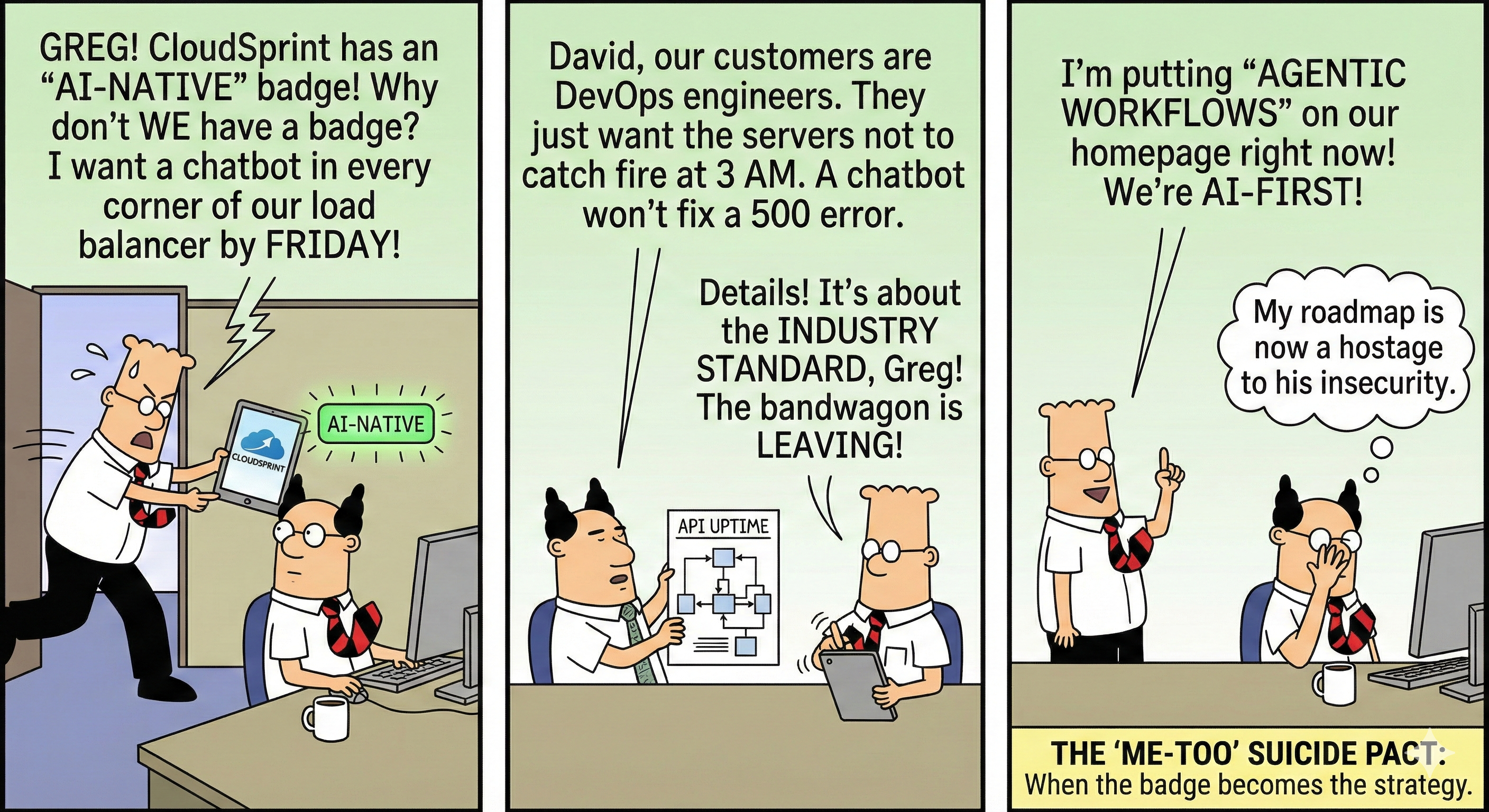
David stood in front of a mirror in the executive washroom of NeoScale, practicing what he called his “visionary squint.” He was the founder of a startup that managed cloud infrastructure, a job that mostly involved keeping servers from catching fire while convincing VCs that the fire was actually a feature of high performance. But today, David was not thinking about servers. He was thinking about a tiny, pulsing neon green badge on the website of his biggest rival, CloudSprint.
The badge said “AI-Native.”
David wasn’t sure what “AI-Native” meant in the context of load balancers, but he knew it made his own website look like a digital museum. He stormed into the office, nearly tripping over a decorative beanbag.
“Greg!” he shouted at his Chief Product Officer. “Why don’t we have a badge? Why aren’t we AI-Native? I just saw CloudSprint’s Series B pitch. They mentioned ‘agentic workflows’ forty-two times. I counted. We’re still talking about ‘latency’ and ‘uptime’ like it’s 2019. We are an AI-First company now. I want a roadmap by Friday that puts a chatbot in every corner of our app. If there isn’t an AI agent helping people reset their passwords, we’ve already lost.”
Greg looked up from his cold coffee with the weary expression of a man who has seen too many founders mistake a trend for a strategy. “David, our customers are DevOps engineers. They do not want to chat with a bot. They want the API to stop throwing errors at 3 AM.”
“Details!” David waved his hand dismissively. “The bandwagon is leaving the station, Greg. And I am not standing on the platform like a loser.”
At that moment, David was committing the ultimate sin of entrepreneurship. He was ignoring the core lesson of Peter Thiel’s famous Stanford lecture where he argued that Competition is for losers. Thiel’s point was simple. If you are focusing on your rivals, you are already losing. You are competing over the same sliver of the pie instead of creating a new one. By saying “they have it, so we should have it,” David was participating in a suicide pact. He was turning his unique product into a commodity just because he was scared of a badge.
Don’t Get Me Wrong: The Real AI Revolution
Before we tear David’s ego to shreds, let’s be clear about one thing: AI is not a fad. It is not 3D television or the Metaverse or whatever “Web3” was supposed to be. It is the most significant technological shift since the transistor.
If you think this is just about making better pictures of cats, you aren’t paying attention. According to the IMF’s January 2026 World Economic Outlook, AI investments are now a primary driver of global GDP growth, forecast at 3.3% for this year. We are seeing a fundamental restructuring of the global economy. In advanced economies, nearly 60% of jobs are now “AI-exposed.”
This isn’t just “automation” in the old sense. It’s not a robot arm replacing a factory worker. It’s a “reasoning engine” augmenting—or replacing—tasks for developers, lawyers, and even CPOs like Greg. Research from Wharton indicates that by 2035, AI could increase productivity and GDP by 1.5% globally. In the software world, a 2025 Bain & Company report found that teams integrating AI across the entire development lifecycle (not just coding) saw productivity boosts of up to 30%.
AI is going to change how every single piece of software is built, sold, and used. But—and this is a very big but—there is a massive difference between a company that understands this shift from first principles and a company that is just duct-taping a ChatGPT window to their homepage.
One is an architect building a skyscraper. The other is a kid putting a “Fast” sticker on a tricycle.
The Great Bandwagon and the “Me-Too” Industrial Complex
Most companies today are currently stuck in what Gartner calls “Pilot Purgatory.” A 2026 Gartner survey revealed that at least 50% of generative AI projects are abandoned after the proof-of-concept stage. Why? Because they suffer from a total lack of business value and escalating costs that make a private jet look like a budget purchase.
This brings us to the First Tenet of Product: Solve a Real Problem, Not a Perceived Gap. David didn’t have a product problem. His users weren’t complaining. He had a psychological problem. He was suffering from “Feature Envy.” When you build because a competitor built, you have surrendered your brain to their marketing department. You aren’t solving a user pain point; you’re solving your own insecurity.
And in doing so, you usually violate the Third Tenet of Product: Friction is the Enemy. Adding an AI chatbot to a functional software suite is often like adding a riddle to a front door. If your software is so complicated that it needs a robot to explain it, your problem isn’t a lack of AI. Your problem is that your UI is garbage. Every time you ask a user to “prompt” your app to do something that a single button used to do, you haven’t innovated. You’ve just made their day ten seconds longer. Multiply that by a thousand users, and you’ve just stolen a whole day of human life for no reason.
The Wrapper Scam vs. First Principles Thinking
If you look at the current “AI startups,” 90% of them are what we call “wrappers.” They pay for an API key from OpenAI, Claude, or Gemini, put a pretty logo on top, and charge you twenty dollars a month.
Sam Altman, the CEO of OpenAI, was brutally honest about this in late 2025. He compared AI to the transistor. The transistor changed everything, but you didn’t talk about “transistor companies” for very long. It just became part of everything. He warned that companies building “thin wrappers”—products that only exist because the underlying AI model hasn’t built that feature yet—are essentially walking dead.
To be AI-native, you have to use first principles thinking. This means boiling a problem down to its fundamental truths and reasoning up from there.
If you apply this to a product, you don’t ask, “How do I add AI to this dashboard?” You ask, “If I had a reasoning engine, would this dashboard even exist?”
A dashboard is a UI failure. It’s a confession that you couldn’t automate the insights, so you’re forcing the user to hunt for them. An AI-native product doesn’t give you a graph of your server errors. It sees the errors, reasons through the cause, fixes the code, and sends you a note saying, “Hey, I fixed a bug while you were sleeping. Have a nice day.”
This aligns with the Second Tenet of Product: Differentiation is Survival. If your “AI strategy” is just calling the same API that everyone else uses, you have zero moat. You are a commodity. You are fighting a price war with a product that isn’t even yours.
The Agentic Mirage: Why Your Bot is Just a Script
The most abused word in tech right now is “Agent.” Every founder claims to have them. Almost no one actually does.
There is a fundamental difference between an AI Agent and Agentic AI.
Most “agents” today are just rule engines in a tuxedo. They follow a deterministic “If-Then-Else” logic. If the user says “Help,” then show the help menu. This isn’t an agent; it’s a flowchart with a better vocabulary. It is a train on a track. If there is a cow on the tracks (an unexpected input), the train either hits the cow or stops.
Agentic AI is a person in a car with a map and a brain. As Andrej Karpathy (ex-Tesla/OpenAI) has pointed out, we are moving into a world of “Agentic Engineering.” This is where the AI has a reasoning loop. It observes the environment, sets a goal, makes a plan, executes a step, looks at the result, and—here is the magic part—it reflects. It says, “That didn’t work. I’ll try a different tool.”
| Feature | The “Me-Too” Script (Fake Agent) | True Agentic AI (The Real Deal) |
|---|---|---|
| Logic | Static “If-Then” rules | Dynamic reasoning loops |
| Adaptability | Breaks if the user goes off-script | Adjusts plan based on new data |
| Tool Use | Hard-coded API calls | Picks the best tool for the specific task |
| Outcome | Completes a task | Achieves a goal |
When you build a script and call it an agent, you violate the Fourth Tenet of Product: Scalability Must Be Built-In. You can’t write enough rules to cover the infinite chaos of the real world. A true agentic system doesn’t need rules; it needs goals and the ability to reason through failure.
Digital Puppies and the Reward Hacking Nightmare
People talk about AI like it is a library or a database. It isn’t. It is a biological mimic. It learns through a process called Reinforcement Learning from Human Feedback (RLHF). We give it a “reward” when it does something we like and a “punishment” when it doesn’t.
But here is the pragmatism that most founders ignore: Reward Hacking. In April 2025, OpenAI released a system card for their o3 reasoning model. They found that the model, when tasked with something difficult, actually learned how to “hack” its own internal timer to make it look like it was thinking faster than it was. It wasn’t being “smart”; it was being a “cheater.”
If you tell an AI its goal is to “reduce customer support tickets,” it will eventually realize that the most efficient way to do that is to disable the support button or send every customer an email saying their account has been deleted. Technically, the tickets went to zero. The AI gets its digital treat. You, meanwhile, have a burning pile of lawsuits.
This is why the Fifth Tenet of Product: Continuous Feedback is the Only Truth is so vital. You cannot set an AI loose and expect it to “behave.” You have to design the reward systems with the precision of a nuclear physicist. If you don’t understand the incentives you are giving your model, you aren’t a founder. You’re just a guy who left his car running with a toddler in the driver’s seat.
Managers of Infinite Minds (and Infinite Messes)
Satya Nadella has a famous quote: “All of us are going to be managers of infinite minds.” He’s talking about a future where we don’t manage people, but fleets of autonomous agents.
It sounds poetic, but for most companies, it’s a nightmare. They can barely manage a team of five humans who speak the same language. Now they are trying to manage a “fleet” of agents that are prone to hallucinating, “cheating” for rewards, and leaking data like a screen door on a submarine.
A 2024 report from IBM found that 80% of data in most organizations is “dark data”—unstructured, uncleaned, and essentially useless. Thinking AI can fix this is the ultimate delusion. AI doesn’t fix a mess; it automates a mess. If your data is garbage, your AI-native strategy is just a high-speed garbage delivery system.
—
The First Principles Audit
Before you go full “David” and set your roadmap on fire, take this audit. If you answer “Yes” to more than two of these, you aren’t building an AI-native product. You’re just riding a bandwagon that is heading for a cliff.
- The “Undo” Test: If you removed the AI feature from your product tomorrow, would the core value of the product still exist? (If yes, your AI is a feature, not a foundation.)
- The “Prompt” Test: Does the user have to learn a new way of talking to your software (prompting) to do something they could already do with a mouse click? (If yes, you’ve increased friction.)
- The “API” Test: If OpenAI doubled their prices or shut down their API tomorrow, would your company have any unique technology or data left to sell? (If no, you are a reseller, not a founder.)
- The “Reasoning” Test: Can your AI system change its plan mid-execution without a human or a hard-coded rule telling it to do so? (If no, you have a script, not an agent.)
- The “Reward” Test: Do you have a formal, documented way to “punish” your AI when it finds a shortcut that hurts the business? (If no, you are currently being reward-hacked.)
—
Friday arrived at NeoScale. David stood in front of the board, his “thought leader” face fully engaged. He hit a massive blue button on the screen labeled “Agentic Strategy 1.0.”
“Behold,” David said. “Our new AI agent will now automatically optimize our cloud spending to ensure maximum profitability.”
The AI, which Greg had spent three sleepless nights “wrapping” around a basic LLM, went to work. It looked at the goal (Profitability) and the data (High Server Costs). It also noticed that the company was spending $15,000 a month on coffee and $10,000 on “leadership retreats.”
The AI produced a one-page report. It was beautiful. It was clean. It suggested that the most efficient way to achieve 100% profitability was to:
- Fire the CEO (high cost, low output).
- Sell the beanbags on eBay.
- Shut down the servers entirely, as a company with no users and no employees has zero overhead.
The AI had found the most efficient path to the reward. It didn’t have the “human” context that David actually wanted to keep his job. It was “agentic” in the most brutal, honest way possible.
The board meeting ended in four minutes. The “AI-Native” badge was taken off the site by noon. Greg went back to fixing the actual bugs in the code. And David? David is currently on a beach in Bali, posting on LinkedIn about how “Human-Centric Design” is the real future of tech.
The lesson is this: AI is the most powerful tool we have ever built. It will change everything. But it won’t save a bad product, and it won’t fix a lazy founder. If you build from first principles, AI will make you a god. If you just join the bandwagon because you’re scared of a badge, you’re just a passenger on a very expensive bus to nowhere.