
The Blood Sport of Ruthless Execution and the Strategy of Saying No
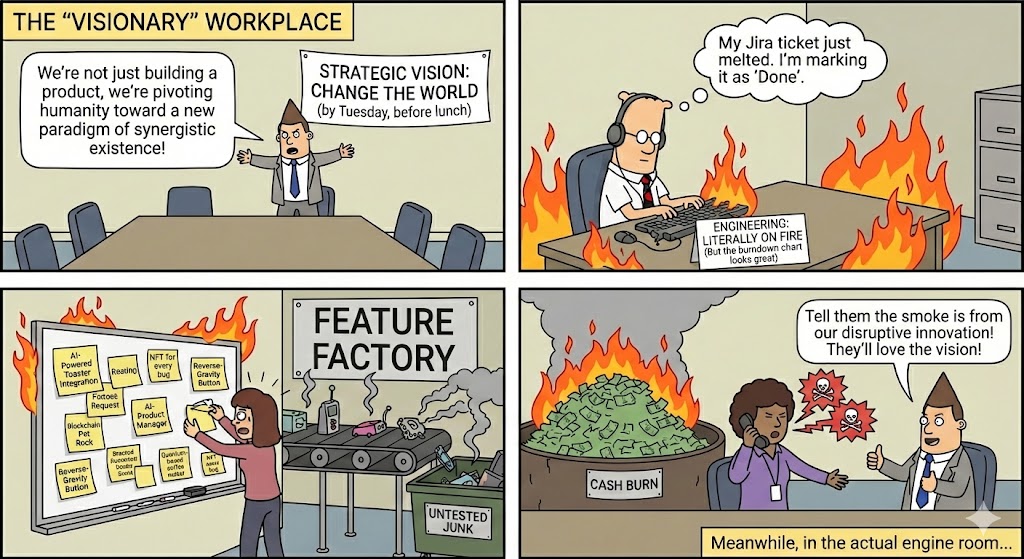
LEGAL DISCLAIMER AND SURVIVAL GUIDE: The following article is a work of high-octane, hallucinogenic fiction. If you read a sentence and think, “Wait, that sounds exactly like my Monday morning stand-up,” that is just your suppressed corporate trauma speaking. Any resemblance to actual persons (living, dead, or currently wearing a Patagonia vest in a coworking space), actual companies, or actual “game-changing” cloud telephony startups is entirely coincidental—in the same way that a power cut in Bangalore hitting exactly when you have a critical deployment is a “coincidence.” The events described have been exaggerated to a degree that would make a Bollywood director blush, specifically to drive the point home without needing a 400-slide deck. In absolute reality, the CEO of the actual company was a legitimate gem of a human being, a strategic wizard who built a top-tier team and successfully navigated us to a glorious acquisition while the rest of us were still trying to figure out how to work the office printer. No CEOs, engineers, or coconuts were harmed in the making of this narrative. Mostly.
The conference room in our MG Road office in Bangalore felt like a pressurized cabin in the middle of a monsoon. It was second half of 2015, and our cloud telephony startup was supposedly “disrupting” how India talked. Outside, the MG Road traffic was a gridlocked symphony of frustrated horns, neon signs, and the smell of wet asphalt. Inside, our CEO—a man who once spent twenty minutes explaining how a coconut was a metaphor for a scalable backend—stood at the head of a mahogany table. He didn’t look at the catastrophic churn numbers on the screen. He didn’t look at the lead engineer, who was vibrating with a rage that only a week of failed SIP trunk deployments can produce.
Instead, he pointed to a slide that featured a single, lonely circle in the middle of a vast white space. “This,” he whispered, “is the void. And our five-year plan is the light that will fill it. We aren’t just routing calls for e-commerce delivery boys anymore. We are architecting the collective consciousness of the mobile-first consumer.”
I looked at my notepad. My only note from the last hour was a doodle of a tombstone with our company logo on it. We were a telephony platform. Our “light” was currently flickering because our primary API was held together by duct tape and prayers. But in that room, the “Void” was more important than the fact that our biggest taxi-aggregator client was currently on the phone with our lawyers because their drivers couldn’t reach their customers.
This is the central pathology of tech. We are so in love with the Light that we forget how to walk in the dark. We treat strategy like a religious text, planning like a prophecy, and execution like a chore for the help.
1. Strategy is the Art of Brutal Subtraction
Strategy is the most abused word in the corporate dictionary. Most people think strategy is a thirty-page slide deck filled with words like “synergy” and “leveraging.” It isn’t. Strategy is simply the art of deciding what you are not going to do.
The Case of the Chinese Wall: The Trade Desk vs. Google
In the late 2000s, the adtech world was a wild west of “do-it-all” giants. Google was building a “full-stack” solution. They wanted the supply side (the publishers), the demand side (the advertisers), and the data marketplace in the middle. They wanted to be the auctioneer, the buyer, the seller, and the guy who owned the building where the auction happened.
Jeff Green, the founder of The Trade Desk, saw this and made a choice that looked like suicide at the time. He focused only on the demand side (the buyers). For the first ten years—long after becoming a public and NASDAQ 100 company—he refused to touch the supply side.
Why? Because it created a strategic moat of trust. Meanwhile, Google was playing a dangerous game. By owning both sides, they created a massive conflict of interest. This lack of a “Chinese Wall” eventually led to the infamous Project Bernanke. While it only came to light years later through legal filings, the groundwork was laid in the late 2000s. Google allegedly used its “God’s eye view” of the market to manipulate auctions, taking data from other advertisers to give their own bids a secret advantage. They weren’t just the house; they were playing at the table with marked cards.
Google’s strategy was “total dominance,” which is great until the market realizes you’re playing a rigged game. The Trade Desk’s strategy was total alignment. They chose not to take the easy money from publishers so they could be the undisputed champion for advertisers. That is a strategy. If your strategy doesn’t hurt a little bit, it isn’t a strategy; it’s just a hobby.
“I’m as proud of many of the things we haven’t done as the things we have done. Innovation is saying no to a thousand things." — Steve Jobs
2. The North Star: Navigation vs. Decoration
Every startup in Bangalore in 2015 had a “North Star Metric.” For some, it was “Total Registered Users.” For others, it was “Number of Cities Launched.” Ours was “Minutes of Usage.”
The North Star is supposed to be the one high-level metric that best captures the core value that your product delivers. If that number goes up, the company is winning. If it goes down, you are dying.
The Vanity Metric Trap
Most companies pick a North Star that looks good on a pitch deck but means nothing for the bottom line. If your North Star is “Registered Users,” but only 2% of them ever make a second phone call, your North Star is actually a black hole.
A real North Star for a cloud telephony company should have been “Successful Call Completions." That is the only thing the customer actually pays for. But that was a hard number to move because it required fixing the messy reality of Indian telecom infrastructure. It was much easier to track “App Downloads.”
- Airbnb: Their North Star isn’t “App Installs.” It is “Nights Booked." That aligns the host, the guest, and the company.
- Practicality Check: If your North Star hits a million but your bank account is empty, did you actually succeed? If the answer is no, throw that metric in the bin.
3. Goals: The Three-Year Fairytale
In tech, we love to pretend we are architects, but we are actually more like gardeners. An architect draws a blueprint and the building doesn’t move. A gardener plants a seed, and then the weather, the bugs, and the soil decide what actually happens.
Theoretical planning tells you to build a three-year roadmap with quarterly milestones. Practicality tells you that a three-year roadmap in tech is just fan fiction for your board of directors. You need to break your goals into three distinct horizons:
- Short-Term (The Dirt): This is the next two weeks. This is where you track every line of code. If you don’t know exactly what is happening on Monday at 9:00 AM, you aren’t planning; you are dreaming.
- Mid-Term (The Horizon): This is the next three to six months. These are bets, not promises. You might say: “We want to reduce latency by 20%.” You don’t know exactly how yet, but that is the target.
- Long-Term (The Star): This is the next year and beyond. This is just a direction. It should be broad enough to allow for a total pivot if the market explodes.
Jeff Bezos once said, “We are stubborn on vision. We are flexible on details." Most tech managers do the opposite. They change their vision every time a competitor releases a feature, but they are stubborn about the stupid details of a project plan made six months ago.
4. KPIs: The Math of Reality
If the North Star is the destination and Goals are the milestones, KPIs (Key Performance Indicators) are the gauges on your dashboard. They tell you if you have enough fuel or if the engine is overheating.
The Trinity of Metrics
“In business, the idea of measuring what you are doing, picking the measurements that count like customer satisfaction and performance, you thrive on that." — Bill Gates
To stay honest, you need three specific types of data:
- Leading Indicators: These tell you what is going to happen. For us, it was “New API Keys Generated.” More keys today meant more call volume in three months.
- Lagging Indicators: These tell you what already happened. Revenue and Churn are lagging. By the time they look bad, the damage was done months ago.
- Health Metrics: These are the constraints. For us, it was “Uptime." You can hit revenue goals, but if your uptime is 90%, you are a dead man walking.
5. Tactical vs. Strategic: The Build-Buy Suicide Note
“Value is discovered by what goes into the basket, not by what is promised on the label." — Thomas Edison
This is where the bodies are buried. A tactical decision is a shortcut to hit a deadline. A strategic decision is an investment in your core identity.
In our Bangalore office, we needed a billing engine. We could build it in-house (9 months) or “buy” it via a third-party API (2 weeks). Tactically, buying was the “smart” move. We hit our targets, and the CEO got to tweet about “velocity.”
But two years later, that vendor was bought by a direct competitor. Suddenly, our “strategic engine” was owned by the enemy. They saw our traffic patterns and raised our prices until our margins vanished.
Case Study: Apple vs. Google Maps
Early iPhones shipped with Google Maps. Tactical win? Yes. Strategic disaster? Absolutely. They gave their primary rival (Google) mountains of location data. Apple eventually spent billions to build Apple Maps from scratch to regain their sovereignty.
6. The Competition: The Rear-View Mirror Trap
Competitive research is like looking in the rear-view mirror while driving a rickshaw at 100 km/h. It’s good to know where the other cars are, but if you stare too long, you’re going to hit a cow.
In 2015, we were obsessed with Twilio. Every meeting was: “What is Twilio doing?" We were so busy trying to build a Twilio-killer that we ignored our own customers who were screaming for better reliability in rural India. We were building APIs for developers in San Francisco while our users in Mysore couldn’t get a dial tone.
When to Ignore, When to Attack
The giants in adtech were afraid to be transparent because their margins relied on a “Black Box.” The winners weren’t those who copied features; they were the ones who out-trusted the competition.
If you spend all your time looking at the other guy, you end up making a “me-too” product. Use the competition only to see where they are failing their customers. Use their mistakes as your roadmap. Don’t copy their features; copy their solutions to problems they haven’t solved yet.
“The competitor to be feared is one who never bothers about you at all, but goes on making his own business better all the time." — Henry Ford
7. Execution: The Religion of the “Friday Pulse”
“Ideas are easy, Execution is everything." — John Doer
Execution is the sound of a thousand small gears turning in the same direction. To drive it, you must kill the “Status Update” meeting—the one where everyone says “on track” while the Jira board looks like a crime scene.
High-Performance Discipline
- The Weekly Detail: If a task takes longer than a week, it’s a project. Break it down. “Working on the database” is a lie. “Migrated user table to new schema” is execution.
- The Friday Pulse: Every Friday, ask: “Did the SIP trunk failover test pass? Yes or no?” No excuses.
- Tolerance for Mistakes: Celebrate the failures that teach (e.g., a new architecture that didn’t scale). Fire the people who make the same mistake three times because they didn’t check the logs.
- Alignment: Driving alignment across silos means telling the sales team “No” and the engineers “Not now.” You build alignment by making everyone’s bonus dependent on the same goal.
8. The Trinity: Strategy, Planning, and Execution
To win, you must treat these as a circular ecosystem, not a linear line.
The Bridge Process
- Strategy (The Why): The choice of where to play and where to ignore. This stays stable for years.
- Planning (The How): The bridge between vision and work. Updated quarterly. Sets the KPIs.
- Execution (The Do): The daily grind. The Friday Pulse. This is the only part that is real.
| Phase | Purpose | Process |
|---|---|---|
| Strategy | Define the Moat | The “Strategic Filter”: Does this help us own our core value? |
| Planning | Map the Route | The “OKR Reset”: Check every 2 weeks. Kill irrelevant goals. |
| Execution | Drive the Engine | The “Alignment Audit”: Does engineering work support sales goals? |
9. The Friday Blood Sync: The Cross-Functional War Room Checklist
I. The Binary Commitment Wall (No “90% Done” Allowed)
Every department lead has 60 seconds to report on their one major “Brick” from last week.
- Engineering: “Did the latency-reduction patch for the Singapore gateway go live?” [Yes/No]
- Product: “Is the final PRD for the ‘Call-Masking’ feature locked and approved by Legal?” [Yes/No]
- Sales: “Did we close the high-volume pilot with the Delhi logistics giant?” [Yes/No]
- Customer Success (CS): “Have all Tier-1 tickets regarding the ‘Dropped Call’ bug from Tuesday been resolved?” [Yes/No]
- Infrastructure/DevOps: “Was the database migration completed without a packet loss event?” [Yes/No]
The Rule of Shame: If the answer is “No,” the lead must explain the Blocker, not the Excuse. Was it a dependency on another team? A tactical mistake? Or did we just overestimate our own brilliance?
II. The Cross-Functional Friction Audit
This is where we find out who is accidentally sabotaging whom.
- The Sales vs. Engineering Trap: Did Sales promise a “custom integration” to a client this week that isn’t on the roadmap? If so, kill the promise or kill the roadmap. You cannot have both.
- The Product vs. CS Gap: CS reports the top 3 complaints from the week. If Product isn’t working on a fix for at least one of them, justify why we are ignoring our customers.
- The Marketing vs. Reality Check: Is Marketing promoting “99.99% Uptime” while Infra is currently holding the servers together with prayers and caffeine? Alignment on the “Truth” is mandatory.
III. The Dashboard of Hard Truths (Hard Metrics)
No “vibe-based” metrics. If it isn’t a hard number, it’s a hallucination.
| Metric Type | Ownership | The “Red Line” (Kill Switch) | Current Status |
|---|---|---|---|
| North Star | Everyone | Successful Call Rate < 98% | |
| Leading Indicator | Sales/Mktg | New API Keys < 50/week | |
| Health Metric | Engineering | P99 Latency > 200ms | |
| Burn Rate | CEO/Ops | Runway < 6 Months |
IV. The Strategic Veto: The Art of Saying “No”
To maintain ruthless prioritization, we must identify what we are dropping to stay fast.
- The “Shiny Object” Cull: What was the most distracting idea suggested this week? (e.g., “Let’s add AI to the dialer!") Action: Officially veto it for the next 90 days.
- Technical Debt Payment: What feature did we decide not to build this week so that Engineering could fix a core stability issue?
V. The Monday Morning “Zero-Hour” Plan
Execution isn’t finished until the pivot for next week is set.
- The Carry-Over Tax: Any “No” from Section I is automatically the Top Priority for Monday 9:00 AM.
- The Clean Slate: If a team is consistently failing their binary commitment, do we need to reduce their scope or change the lead? (Be brutal, be honest).
- The “Delhi” Sign-off: Before the CEO catches that flight back to Delhi, does he agree that this week’s “Bricks” actually support the “Bridge”?
The Closing Question: “Is there any silent disaster currently brewing that no one has mentioned yet?”
(Silence for 10 seconds. If someone speaks up, stay another hour. If not, go home.)
10. Prep To Prevent The Friday Blood Sync: Get The Strategy and Plan Right
To ensure the “Friday Blood Sync” doesn’t turn into a finger-pointing exercise, you need the underlying scaffolding to be just as ruthless. If the Execution is the engine, the Strategic and Planning frameworks are the chassis and the GPS.
Here is the three-section breakdown for the Strategic Framework, the Planning Framework, and the final Measurement Scorecard.
I. The Strategic Framework: The “Moat & Anchor” Model
This framework is used only once a quarter (or whenever a massive market shift occurs). Its goal is to define the boundaries of your universe.
1. The Strategic Filter (The “Moat”)
Every potential initiative must pass through the Moat Test. In our cloud telephony world, our moat was “Unrivaled Latency in Tier-2 Indian Cities."
- The Question: Does this project deepen the moat?
- The Outcome: If it doesn’t improve call quality or reliability, it is a “Secondary Priority.” No matter how “cool” the feature is.
2. The Subtraction List (The “Anchor”)
Strategy is defined by what you drop.
- The List: Formally document the three high-revenue opportunities you are ignoring this quarter to stay focused.
- Example: “We are ignoring the Enterprise Video market to own the SMB Voice market.”
3. The Chinese Wall Protocol (Integrity)
Referencing our Trade Desk vs. Google lesson:
- The Rule: Define where your interests stop to maintain trust.
- Action: Document the “No-Go” zones. (e.g., “We route the calls; we never compete with our customers by launching our own call center.")
II. The Planning Framework: The “Rolling Horizon” (70-20-10)
Planning is not a fixed document; it is a living breathing organism. We use the 70-20-10 rule to ensure we aren’t hallucinating about 2029 while the 2026 servers are smoking.
1. The 70% (The Dirt - 2-Week Sprints)
- Granularity: High. Individual tasks, owners, and hourly estimates.
- Flexibility: Zero. Once a sprint starts, the only way to change it is to declare a “State of Emergency.”
2. The 20% (The Horizon - 3-Month OKRs)
- Granularity: Medium. These are “Key Results” (e.g., “Migrate 40% of traffic to the new SIP gateway”).
- Flexibility: Moderate. If the “Dirt” reveals a major technical blocker, we pivot the Horizon.
3. The 10% (The Star - 1-Year Vision)
- Granularity: Low. Themes and North Stars.
- Flexibility: High. This is our “Fan Fiction.” It exists to keep the CEO’s “Delhi” dreams aligned with the Bangalore reality.
III. The Measurement Scorecard: The “Hard Truth” Ledger
This is the final scorecard that combines the Strategy, Planning, and Execution into one brutal document. It is the only thing that matters during the Friday Blood Sync.
| Category | Metric | The “Red Line” (Panic Mode) | Why It Matters (The Strategy) |
|---|---|---|---|
| Strategy | Moat Strength | Latency > 150ms | If we lose our speed, our “Moat” is just a dry ditch. |
| Planning | Say/Do Ratio | < 80% Commitments Met | If we hit < 80%, we aren’t “ambitious,” we are “delusional” planners. |
| Execution | Brick Velocity | < 5 Major Tasks/Week | If the gears stop turning, the bridge never gets built. |
| Cross-Fun. | Friction Index | > 2 Vetoed Sales Deals | If Sales is selling “Vaporware,” the engineers will burn out and quit. |
IV. The “Perfect Execution” Audit
To ensure this isn’t just more “theoretical practice,” the leadership must answer three questions every Sunday night before the week begins:
- The Sovereignty Check: Are we “Building” the core and “Buying” the fluff? (Did we accidentally outsource our soul to a vendor this week?)
- The Competition Blindfold: Are we building this feature because a competitor released it yesterday or does it really help us differentiate in the market to add value to our customers’ business ?
- The Alignment Sanity: If I ask a junior developer and the Sales Lead what our #1 goal is, will they give me the same answer?
11. The Closing: Back To The Story
The boardroom in MG Road finally emptied around 4:00 AM. The “Void” slide was still glowing, but the CEO had already caught the red-eye flight back to Delhi. I stayed behind with the lead engineer. We didn’t talk about “sentimental resonance engines.”
We sat in the dark, listening to the rain, and talked about rewriting three lines of code so delivery drivers could receive calls at breakfast. We looked at the real KPIs—the ones showing our server was about to melt—and ignored the “North Star” of App Downloads.
That company did get acquired after a few years. Everyone did make some money. But they were so busy being “strategic” that they forgot to be functional. They had the map and the route and they could have made it much bigger than Twilio, but they let the engine catch fire because they were too busy arguing about the destination.
Hindsight is a great teacher.
Strategy is your map. Planning is your route. Execution is your engine. If you spend all your time looking at the map while the engine is on fire, you are never going to get where you are going.