
Why DOOH Brought a Knife to the CES 2026 Gunfight: The 12-Month Roadmap to a 'Minority Report' Reality for CES 2027.
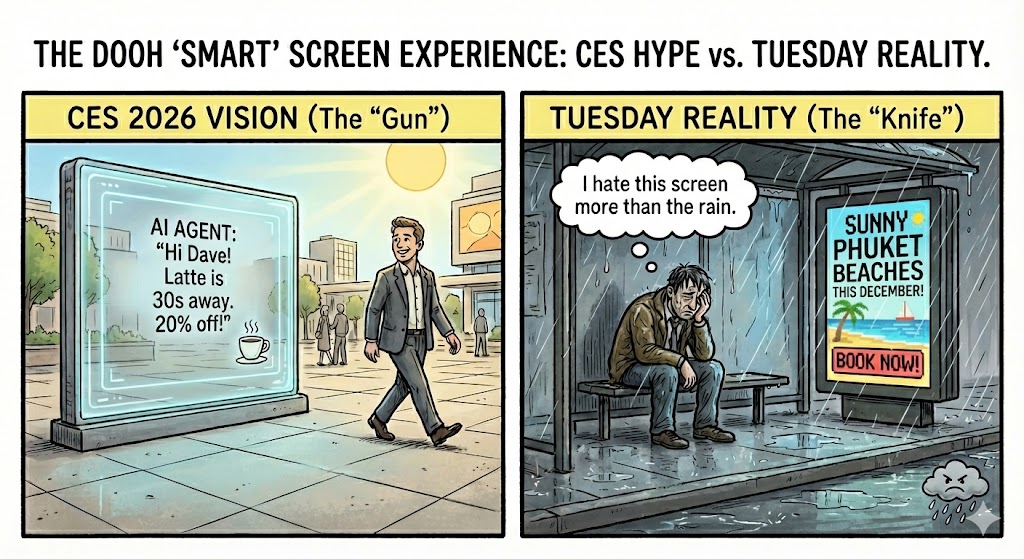
The Pre-CES Hype vs. The Rainy Tuesday Reality
Next week, Las Vegas will turn into a neon shrine for CES 2026. You’re going to see “Agentic AI” that can order groceries for you, holographic displays that float in mid-air, and transparent OLEDs that look like something out of Minority Report.
The press releases will scream about “The Future of Connection.” And then, you will fly home, stand at a digital bus shelter in the rain, and watch a static JPEG of a sunscreen bottle rotate on a 60-second loop.
This is the schizophrenia of our industry. We have Ferrari hardware running on Flintstone software.
Picture this. It’s a Tuesday evening in early December. A sudden, nasty downpour hits the city. At a digital bus shelter, twenty people are huddled together, wet, miserable, and furiously checking their phones for delayed bus times. They are cold. They are stuck. They are arguably the most captive audience on the planet at that precise moment.
On the 75-inch, 4K, 5G-enabled screen next to them, what plays?
A luxury car ad. Then a perfume ad featuring a model frolicking in a sunlit field (mocking them). Then a static poster saying “Visit Phuket this December.”
The people ignore the screen completely. Actually, they don’t just ignore it; they resent it. It’s just light pollution laughing at their misery.
To a normal person, this is just annoying. To me, as a technologist who has spent 25 years building the plumbing for AdTech and streaming, it is a crime scene.
We are witnessing the destruction of value in real-time. That screen had twenty high-intent consumers standing inches away from it. But because the industry is running on logic from 1998, we showed them irrelevant noise.
If that screen were an Uber, the price would have surged 3x because demand spiked. If that screen were a TikTok feed, the content would have read the room and adapted. But because it is Digital Out-of-Home (DOOH), it played a pre-scheduled loop from a playlist uploaded last Tuesday by Dave in Accounting.
This disconnect is what I call the “Digital Billboard Dilemma." In my previous article, “Why We Are Still Using Floppy Disks in a 5G World," I ranted about the absurdity of manual content updates. But recently, a piece by Premesh Purayil “Introduction to OOH/DOOH from a Web Publisher’s View” struck a nerve. Premesh correctly identifies that OOH is a “one-to-many” medium trying to survive in a “one-to-one” digital world.
Premesh is right. But let’s be honest: We are using “one-to-many” as an excuse to be lazy.
We are selling Occupancy (filling the slot) when we should be selling Yield (maximizing the value of the moment). We are treating billion-dollar digital networks like patches of drywall.
Here is the brutal reality of why our current model is broken, and exactly how we fix it before the retail giants eat our lunch.
The “Uber Test”: Why Static Multipliers are Financial Suicide
In the ride-sharing world, price is a function of demand. Uber doesn’t ask, “What is the average price of a ride on a Tuesday?” It asks, “How many people need a ride right now?”
In DOOH, we fail this test every single day.
Currently, most “Programmatic” DOOH transactions rely on a Static Impression Multiplier. This is a hard-coded number in the bid request that essentially says, “On average, 8 people see this screen at this hour.”
This is financial suicide. When that rainstorm hit the bus shelter, the audience didn’t just double; the value of that audience tripled. These aren’t just passersby anymore; they are a captive audience stuck in a specific location with a specific need (dryness, comfort, transport updates).
But here is the sheer stupidity of our so-called “Tech” industry: The screen doesn’t know it’s raining. The media player is just a dumb box blindly following a playlist. We pat ourselves on the back for being “Digital,” yet operationally, we are functioning exactly like a paper poster. The only difference is that a paper poster doesn’t crash and reboot in front of a client. We have deployed 5G connections, AI cameras, and edge processors, only to use them to display a static JPEG based on a contract signed three months ago. That isn’t “Technology”; that is just expensive electricity.
The Fix: Dynamic Bid Enrichment
To stop being “Paper with a Plug,” we need to move from Static Averages to Real-Time Census.
- The Tech: Modern screens have cameras or LiDAR sensors (like Quividi or AdMobilize). They count the crowd size in real-time.
- The Mechanism: Instead of a static config file, the media player must inject the live count into the OpenRTB bid request.
- Old Way: {“impmul”: 5} (Based on historical data from last year)
- New Way: {“impmul”: 22, “situation”: “crowd_surge”, “weather”: “heavy_rain”}
- The Financial Upside: The SSP instantly raises the Bid Floor. If the CPM is $10, the surge price is $30. Buyers (like Uber or a coffee chain) will happily pay it because they aren’t buying “exposure”; they are buying “verified attention.”
As Jeff Green, CEO of The Trade Desk, famously said:
“Walled gardens aren’t incentivized to make the open web effective. They are incentivized to grade their own homework."
In DOOH, we are grading our own homework by using static multipliers. We tell buyers “8 people saw this” because the spreadsheet says so. Real-time data forces us to be honest—but it also allows us to charge for the surge.
The Structural Failure: The “Dumb Loop” vs. The “Smart Pod”
So why haven’t we fixed the pricing? Because our plumbing is broken. We are addicted to the Loop.
In the physical world, a landlord wants 100% occupancy. If you have 10 apartments, you want 10 tenants. In DOOH, this translates to the “Loop”—usually a 60-second rotation with six 10-second slots.
If a Media Owner sells 5 slots, they panic. They fill the 6th slot with a “House Ad” or a generic weather widget just to keep the loop full.
- The Business Failure: This signals Inventory Deflation. You are telling the market, “My screen is always available, and I have no better use for this time.”
- The Opportunity Cost: You are diluting the value of your paying advertisers by sandwiching them next to free filler.
Compare this to Connected TV (CTV). In the streaming world, no one buys a “loop.” In fact, no one even buys a whole “pod” (the commercial break). They buy a specific opportunity within that pod, governed by complex, real-time logic.
-
The CTV Ad Pod (The Yield Model):
- Competitive Separation: The ad server knows not to play a BMW ad right after a Mercedes ad. It protects the brand’s value.
- Frequency Capping: It knows I’ve already seen that insurance ad 4 times this hour, so it swaps it for a CPG brand to avoid ad fatigue.
- Yield-Per-Second: The first slot in the pod might cost $30 CPM, while the last slot costs $15. The pod is deconstructed to maximize revenue.
-
The DOOH Loop (The Real Estate Model):
- Zero Separation: I see a McDonald’s ad followed immediately by a Burger King ad because two different DSPs bought “Slot 3” and “Slot 4” blindly. The value of both ads is destroyed instantly.
- Rigidity: If demand drops, we still play the full 60-second loop with filler. If demand spikes (like the rain example), we can’t extend the loop or insert a premium “break.”
The Fix: Kill the Loop.
We need to adopt Dynamic Ad Pods. If you only have 3 paying ads, play 3 ads and then switch to high-value content (news/sports) that actually engages viewers, rather than “filler.” If demand surges, expand the pod. Treat time as a fluid asset, not a rigid bucket.
As Reed Hastings, Co-Founder of Netflix, understood early on:
“Stone Age. Bronze Age. Iron Age. We define our history by the technology we use."
The Loop is the Stone Age of AdTech. It’s a blunt instrument in a precision world.
The “Content Carrot”: If You Don’t Have a Show, You Must Be a Service
In CTV, the viewer tolerates the ad because they are waiting for The Office or Yellowstone to come back on. The content is the “Carrot.” They hate the ad, but they love the show, so they stay.
In DOOH, there is no carrot. The ad is the content.
Unless you are in Times Square, Piccadilly Circus, or Shibuya Crossing—places I’ve visited where tourists actually stand still to film the 3D whales—no one is “tuning in” to your screen. To a commuter rushing to a train, a generic brand video is invisible. It is “banner blindness” at physical scale.
The Fix: Contextual Utility (Service-as-an-Ad)
If you can’t entertain them, you must help them. You have to earn the right to be looked at.
- The Mechanism: We need to shift from Video Files to HTML5 Templates. Instead of the DSP sending a flat .mp4, it sends a dynamic template.
- The Logic: The media player (or Edge Server) populates the template fields based on real-time triggers.
- Trigger: Rain > 5mm/hr → Swap Creative A (Iced Coffee) for Creative B (Hot Chocolate).
- Trigger: Transit Delay > 10m → Insert a live “Wait Time” ticker inside the ad creative.
If your ad doesn’t react to the environment, it is dead pixels.
Marc Pritchard, CBO of P&G, has been screaming about this for years:
“We have a media supply chain that is murky at best and fraudulent at worst. We need to clean it up."
Showing a sunscreen ad during a rainstorm isn’t fraud, but it is incompetence. It’s a waste. And in 2026, waste is the one thing no CMO will pay for.
The Business Landscape: Evolve or Be Eaten
The market is consolidating, and the “Landlords” (Media Owners who just rent space) are running out of time.
While traditional OOH companies fight over billboards, Retail Media Networks (RMNs) are eating the world. Walmart Connect, Uber Advertising, and Chase Media Solutions are growing at 20%+ while the general ad market crawls at 4%.
Why? Because they own the Loop and the Data.
- Traditional DOOH says: “We think 500 people saw this ad.”
- Retail Media says: “We know 50 people bought the product after seeing this ad.”
The Consolidation Signal
Look at the recent acquisition of Place Exchange by Broadsign. This is the canary in the coal mine. The pipes are merging. The industry is realizing that you cannot have separate silos for “CMS” (Loop management) and “SSP” (Programmatic sales).
The winners of 2026 will be vertically integrated platforms that control the glass and the transaction. If you are a small media owner using a generic CMS and a third-party SSP, your margins are about to get squeezed by the tech giants who can offer “Programmatic Guaranteed” efficiency at scale.
Brutal Reality for CFOs: Stop looking at Occupancy Rate. Occupancy incentivizes you to fill the loop with cheap filler just to say “we are full.” Start looking at Revenue Per Available Second (RPAS). It is better to have a black screen for 50 seconds and play one $100 ad for 10 seconds, than to play six $5 ads just to “fill the loop.”
Brian O’Kelley, CEO of Scope3, puts it bluntly regarding carbon and waste:
“Programmatic advertising creates massive amounts of carbon emissions… mostly from ads that no one sees or that don’t drive value."
Every time we download a video file to a player that never plays it, or play an ad to an empty room because the “loop” said so, we are burning cash and carbon.
The Enabler: Why SSAI is the “Plumbing” of the Future
None of the above (Dynamic Multipliers, Ad Pods, Contextual DCO) works if we rely on the current hardware-heavy approach. We cannot trust a $200 Android media player to handle complex logic, API calls, and real-time bidding without crashing.
But we already solved this in Streaming.
I spent years building Server-Side Ad Insertion (SSAI) systems for the US streaming market. We realized early on that smart TVs were actually pretty dumb. So we moved the brain to the cloud.
- The Cloud constructs the stream: It checks the weather, checks the crowd size, calls the Transit API, and stitches the perfect ad into the video stream.
- The Screen is dumb: It just plays the video stream it receives. No logic. No crashing. No black screens.
SSAI allows DOOH to function like a FAST Channel (Free Ad-Supported TV). It is the only way to scale “Smart” ads without replacing millions of hardware units on the street. It turns your billboard into a linear TV channel that just happens to be on a sidewalk.
As Anthony Wood, CEO of Roku, proved:
“The future of TV is streaming."
Well, the future of Billboards is streaming too. We just haven’t admitted it yet.
Closure: The CES Challenge
Next week at CES 2026, you will see a lot of dazzling screens. You will see an 16K resolution. You will see transparent glass. You will see “AI Agents” that promise to run the world.
Don’t be distracted by the shiny objects.
Ask the hard question: “Is this screen smart enough to know I’m standing here, or is it just playing a loop?”
Because if we don’t fix the plumbing underneath these beautiful screens, we aren’t building the future. We are just building the world’s most expensive digital wallpaper.
Let’s replay that Tuesday evening with a new stack in place.
The rain starts.
- The Sensor detects the crowd surge (20 people) and the weather (Rain).
- The SSP updates the bid request: multiplier: 20, context: rain.
- The Yield Engine (killing the loop) triggers a surge price. A ride-share app wins the bid at $45 CPM (up from $15).
- The DCO Engine builds a creative on the fly: “Don’t stand in the rain. Your ride is 2 mins away. Use code RAIN20 for 20% off."
- The Outcome: The audience looks up. They feel understood. They feel helped. Three people book a ride immediately.
The Media Owner made 3x revenue.
The Advertiser got 3x conversions.
The Consumer got a solution, not pollution.
The bus is leaving. Make sure you’re on it.