
AdTech's AI Reckoning: A Kodak, or Blackberry Moment?
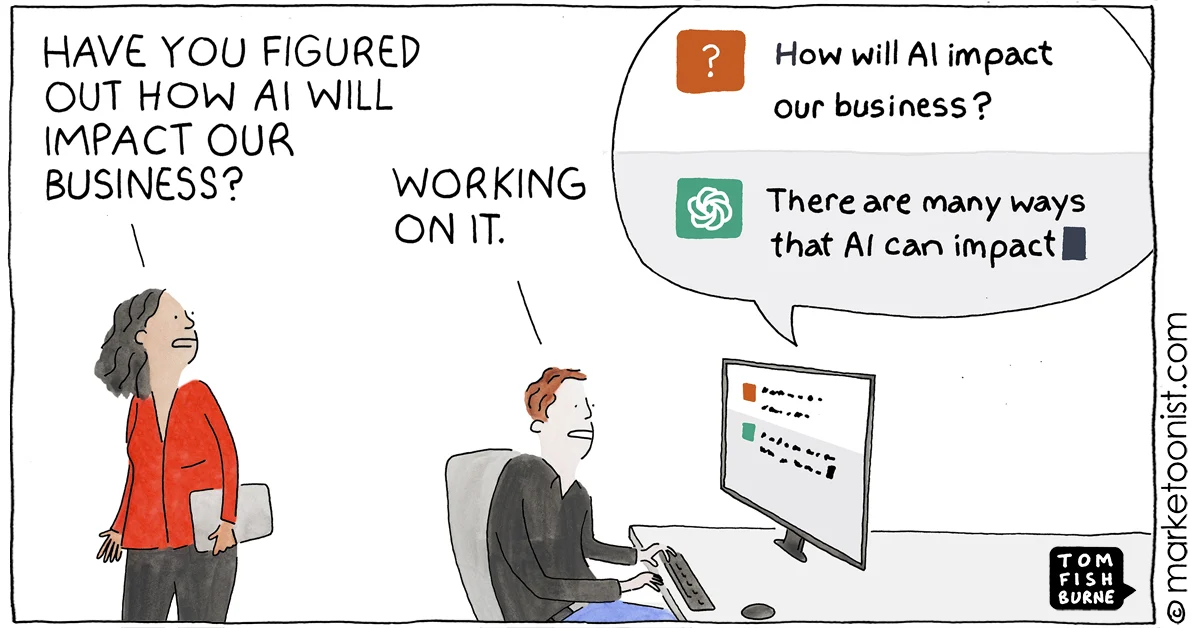
The global advertising industry is not dying; in fact, it is thriving. Global advertising spend is forecast to surpass an unprecedented $1 trillion for the first time in 2026, while the digital advertising sector alone is projected to exceed $350 billion by 2030. AdTech as an industry segment will undeniably remain and continue to expand. However, the rules of the game and perhaps the game itself, are poised for a radical rewrite over the next two years.
We are entering the “AI Acceleration Era” (2026-2028), where Agentic AI is no longer just an experimental tool, but will become the fundamental operating logic of marketing and commerce. As conversational interfaces synthesize information and autonomously guide real-time purchase decisions, entirely new walled gardens are growing by leaps and bounds. Platforms like OpenAI and Anthropic are rapidly replacing traditional search engines as the “front door” to the internet, signaling a structural shift in how brand discovery and economic value are created.
History proves that while entire industry segments rarely disappear overnight, individual companies frequently do when they fail to recognize technological inflection points. As the old guard struggles and new leaders emerge, a complete paradigm shift is not just expected in AdTech, it is strictly necessary for survival.
The Anatomy of Corporate Hubris and Historical Paradigm Shifts
The history of corporate extinction is rarely a story of sudden, unforeseeable catastrophe. It is almost always a story of willful blindness wrapped in the comforting blanket of quarterly earnings. The decline of companies like Kodak, Blockbuster, and BlackBerry is frequently portrayed by business schools as catastrophic, isolated failures. But viewed through the lens of industrial evolution, their demise was a necessary transition, a shedding of obsolete skin that allowed entirely new ecosystems to thrive.
Kodak possessed over 7,000 patents and literally invented the core technology behind the digital camera, yet it filed for bankruptcy in 2012. Why? Because its executive boardroom could not stomach the idea of cannibalizing their highly lucrative, 80% market-share photographic film cash cow. Blockbuster executives famously laughed Netflix out of the room, hopelessly wedded to the predictable, highly margin-accretive cash flow of retail late fees. BlackBerry commanded the enterprise mobile market with an iron fist, only to watch its empire evaporate overnight because its leadership treated the touchscreen app ecosystem as a frivolous consumer toy, failing to anticipate the shift toward app-centric operating systems. These are not just stories of companies that missed the boat; they are stories of massive, entrenched organizations that looked the asteroid dead in the eye and decided they could simply out-earn the impact.
The advertising technology (AdTech) industry, currently navigating the turbulence of 2026, is standing precisely on the precipice of its own evolutionary filter. Driven by a shift toward digital-first marketing strategies, the global online advertising market is projected to surpass $350 billion by 2030. Yet, for the better part of two decades, the digital advertising ecosystem has been a bloated, byzantine machine built on the crumbling foundational physics of third-party cookies, fragmented identity graphs, and a labyrinthine supply chain that extracts a staggering “tech tax” just to move a digital banner from a buyer to a seller. But the asteroid hurtling toward this ecosystem is not merely another privacy regulation out of Brussels or another Apple iOS update. It is the widespread commercialization and deployment of Agentic Artificial Intelligence.
To truly understand the magnitude of this impending disruption, one must look at the historical paradigm shifts that rewired the global economy. The advent of the personal computer decentralized compute power, placing a mainframe on every desk. The mobile era tethered that compute to human geography, birthing the gig economy and the surveillance capitalism model of location tracking. Cloud computing transformed massive capital expenditures into operational expenditures, enabling infinite scale and giving birth to the modern Software-as-a-Service (SaaS) industry.
Today’s AI wave is fundamentally different from the dot-com era, and the AdTech industry misunderstands this at its peril. The current AI infrastructure build-out is not being led by unprofitable startups burning cash on Super Bowl ads. It is being orchestrated by the most profitable technology monopolies in human history, reinvesting billions of dollars of free cash flow into semiconductors, data centers, and power grids. Generative AI requires over 1,000 times the compute of perception AI, and the shift toward Agentic AI—systems capable of autonomous reasoning, context building, and execution—requires an additional 30 to 100-fold increase in compute power.
For AdTech, this means the software paradigm is spontaneously combusting. Since the dawn of programmatic advertising, the industry has relied on isolated SaaS point solutions. There was a tool for dynamic creative, a tool for attribution, a tool for bidding, and a tool for audience segmentation. By early 2026, the State of Martech report charted a “digital Cambrian explosion,” noting that over 1,200 traditional platforms had vanished into the ether. In their place emerged a swarm of AI-native nano-apps and hyper-light agents that flicker into being on command to execute tasks and vanish just as quickly. The center of gravity has violently shifted. Artificial intelligence is no longer a tool within the marketing stack; AI is the marketing stack.
The impending AdTech extinction event will not be evenly distributed. It will obliterate the “long tail” of independent middlemen, decimate the white-collar labor force of global agency holding companies, and force a brutal, zero-sum reckoning for legacy walled gardens that rely on monetizing human search queries. By the end of 2028, the concept of a human media planner logging into a Demand-Side Platform (DSP) to manually tweak cost-per-click (CPC) bids based on deterministic identity graphs will look exactly like a Kodak film development darkroom: an archaic curiosity of a bygone era.
The Macroeconomic Physics of Agentic AI: Efficiency Shocks and the Labor Reset
We are currently transitioning from the “AI Experimentation Era” into the “AI Acceleration Era” (2026-2028), moving rapidly toward the “AI Elevation Era” (2028-2030), where intelligent systems will make autonomous decisions and free human capital to dream up capabilities currently beyond our imagination. To predict the victors and the victims of this timeframe, we must analyze the underlying unit economics of AI compute and inference, as well as the macroeconomic impact of this technology on the global labor force.
In late 2023 and 2024, the narrative was entirely dominated by the sheer, staggering cost of training frontier AI models. Meta’s LLaMA 3 required 16,000 Nvidia H100 GPUs, and OpenAI’s GPT-4 cost an estimated $80 million to $100 million to train. Under those economic conditions, advanced AI would remain the exclusive playground of a few trillion-dollar hyperscalers. However, the release of DeepSeek R1 completely inverted this logic and sent shockwaves through the global tech sector. The Chinese AI startup achieved state-of-the-art reasoning performance by training its model for a mere $6 million using 2,000 older Nvidia H800 GPUs.
DeepSeek achieved this through radical architectural innovations. They utilized a Mixture-of-Experts (MoE) architecture, which activates only 37 billion out of 671 billion parameters for processing each token, drastically reducing computational overhead without sacrificing output quality. Furthermore, their Multi-head Latent Attention (MHLA) mechanism reduced memory usage to between 5% and 13% of previous methods, while optimized distillation techniques allowed reasoning capabilities to be transferred from massive models to smaller, highly efficient ones.
This radical deflation in inference costs is the true catalyst for AdTech disruption. It triggers a massive Jevons Paradox: as the cost of AI inference plummets, the demand and utilization of AI agents explode exponentially. When AI reasoning becomes effectively free to deploy at the edge, the entire premise of “programmatic bidding algorithms” becomes obsolete. We move from an ecosystem where algorithms follow rigid, human-coded rules (e.g., “bid $2.00 if the user is male, 18-34, and visited a checkout page in the last 7 days”) to an ecosystem of autonomous agents negotiating with each other in real-time, operating on semantic understanding rather than deterministic code. Agentic AI turns advertising from a reactive, batch-processed system into continuous, autonomous orchestration.
The macroeconomic fallout of this transition will be severe. Goldman Sachs Research estimates that innovation related to artificial intelligence could displace 6% to 7% of the total US workforce if widely adopted. While they note this impact is likely transitory as new job opportunities emerge, the short-term disruption will be brutal, particularly for white-collar information workers. Bloomberg reports that AI could replace more than 50% of the tasks performed by market research analysts and an astonishing 67% of the tasks executed by sales representatives. In the advertising sector, this translates to a severe “white-collar recession,” where the entry-level roles that historically served as the training ground for the industry—compiling reports, manually pulling data, writing junior copy—are entirely automated out of existence.
However, this transition is not without intense friction. Gartner predicts that by the end of 2027, over 40% of enterprise Agentic AI projects will be canceled due to escalating costs, unclear business value, and fragile governance. The market is currently flooded with “agent washing”—the rebranding of legacy chatbots and basic robotic process automation (RPA) tools as “agents” to appease eager shareholders. The survivors in 2028 will not be the companies that slap an AI chat interface onto a legacy DSP; the survivors will be those that rebuild their infrastructure around unified data intelligence, allowing true agents to see, decide, and act faster than any human team. As Scott Brinker pointed out, the Model Context Protocol (MCP) is emerging as the foundational infrastructure for agentic communication, meaning the new moat is not the software interface, but the underlying data protocol itself.
The Collapse of the Old Gods: Walled Gardens vs. Agentic Search
For the past decade and a half, the digital advertising ecosystem has been a feudal society ruled by an oligopoly of dominant warlords: Google, Meta, and Amazon. These “walled gardens” extracted massive rent from the global economy by monopolizing human attention and hoarding deterministic data. They dictated the rules of engagement, and independent AdTech players were forced to scrape a living off the crumbs that fell outside their walls. But the very architecture of their dominance—the traditional search engine and the scrolling social feed—is under existential threat from a new breed of AI walled gardens like OpenAI and Anthropic.
Generative AI platforms are rapidly becoming the new front doors to the internet. Users are bypassing traditional search engines entirely, instead utilizing conversational interfaces that synthesize vast amounts of information, personalize results, and guide purchase decisions in real-time without the user ever needing to click a blue link. This creates the phenomenon of “Agentic Search,” which is fundamentally hostile to the economic foundations of the ad-funded open web.
When a human searches for a product or an answer, they navigate through web pages, clicking on display ads and generating revenue for the publisher and the ad network. When a Large Language Model (LLM)-based agent searches, it behaves like a swarm of digital locusts. Studies comparing agentic search behavior to human search reveal a terrifying “search explosion.” AI agents generate 10 to 60 times more web traffic than human users for identical queries. An agent might visit 146 distinct web pages to answer a question that a human would have solved with a single click. Yet, this massive traffic generates exactly zero ad revenue, because AI agents do not view display ads, they do not click on affiliate links, and they do not subscribe to paywalls.
This “economic bypass” starves long-tail publishers of oxygen. Without monetization, the open web risks total fragmentation or collapse, as content creators lose all financial incentives to share knowledge. The data ecosystem that trained the very models destroying it will dry up, leaving only vast, enclosed data fortresses.
This dynamic is forcing a brutal realignment among the legacy tech giants. Meta announced a suite of AI-powered advertising tools in early 2025 designed to automate campaign setups and expand AI optimizations. They are desperately trying to prove that their algorithmic “Advantage+” campaigns can drive performance even as underlying signal loss accelerates. Google, fighting a massive multi-front war against antitrust regulators and the existential threat of ChatGPT, is embedding its Gemini models into every facet of its Performance Max (PMax) campaigns. Both Meta and Google are effectively asking advertisers to completely surrender control and blindly trust the machine to find conversions.
Meanwhile, the new AI walled gardens are maneuvering to become the ultimate arbiters of commerce. OpenAI recently appointed Omnicom’s PHD as its global media agency of record, a highly aggressive move signaling a massive push to cement ChatGPT as a ubiquitous consumer brand and transition from in-house marketing to formal, large-scale media buying. Anthropic is aggressively marketing Claude, even launching Super Bowl ads directly targeting OpenAI’s intention to introduce ads into ChatGPT.
The infrastructural decisions made by these AI platforms in 2026 will dictate whether the next era of digital advertising is open and ecosystem-inclusive, or if it simply replicates the walled garden dynamics of the past decade on an even more restrictive scale. If a consumer uses ChatGPT as their primary interface for booking travel, buying insurance, and ordering groceries, OpenAI effectively becomes the ultimate “zero-click” gatekeeper. In this scenario, OpenAI and Anthropic will charge toll fees for agentic access that will make Google’s historic search margins look like pocket change.
The Independent Programmatic Bloodbath: DSPs, SSPs, and the Squeezed Middle
Trapped between the desperate legacy monopolies and the ascendant AI behemoths is the independent AdTech sector. This is a fragile, highly fragmented ecosystem of Supply-Side Platforms (SSPs), Demand-Side Platforms (DSPs), and data brokers that survive by arbitraging the inefficiencies of the open internet. By 2028, this sector will experience a mass extinction event that mirrors the collapse of the over-leveraged telecoms during the dot-com crash.
The fundamental value proposition of a traditional DSP is workflow automation, audience segmentation, and bidding efficiency. But if AI agents become the new integration layer—stitching together workflows across apps, data sources, and cloud warehouses instantly—the traditional software interface becomes entirely irrelevant. As Scott Brinker noted, generative AI and agentic automation are replacing old integration tools, turning AI agents into the new Integration Platform as a Service (iPaaS). Why would a brand pay a 15% to 20% take-rate to a DSP when a highly tuned, locally hosted open-source AI model can autonomously negotiate media buys directly with a publisher’s API?
Let us examine the current titans of the independent space. The Trade Desk (TTD) is widely considered the undisputed king of the independent DSPs. In 2024, TTD reported $2.44 billion in annual revenue, an impressive 26% increase from the previous year, and its Q1 2025 revenue hit $616.02 million, maintaining a 25.4% year-over-year growth rate. Despite maintaining a fortress balance sheet with $1.7 billion in cash and minimal debt, The Trade Desk is inherently vulnerable to the coming paradigm shift. It faces relentless pricing pressure from Amazon’s DSP, and the overarching threat of market saturation as digital advertising matures. More critically, TTD’s entire strategic moat for the privacy era is built around Unified ID 2.0 (UID2). If deterministic identity graphing is rendered obsolete by AI-driven predictive modeling and Agentic search, TTD’s core value proposition evaporates.
The middle tier of independent AdTech is already showing severe signs of strain, divergence, and a desperate reliance on Connected TV (CTV) to mask the terminal decline of standard programmatic display advertising.
| Independent AdTech Firm | Financial Period | Revenue / Contribution Profile | Key Profitability Metrics | Growth Drivers & Strategic Context |
|---|---|---|---|---|
| Viant Technology | Q2 2025 | $77.85 Million (Total Revenue) | Gross Profit: $35.88M, Net Income: $1.78M | Net income represents a razor-thin 5% of gross profit. Surviving, but barely profitable. |
| Magnite (SSP) | Q1 2025 | $155.8 Million (Total Revenue) | Adj. EBITDA: $36.8M, Non-GAAP EPS: $0.12 | CTV Contribution ex-TAC grew 15% to $63.2M. Heavily reliant on streaming growth. |
| PubMatic (SSP) | Q1 2025 | Revenue ahead of guidance | Strong Cash Flow & Adj. EBITDA | CTV outpacing market, growing >50% YoY (excluding political spend). |
Magnite, the largest independent SSP, is clinging to premium video as a life raft. Its Q1 2025 results highlighted strong CTV growth, fueled by massive partnerships with Netflix (now live with programmatic capabilities in the US, EMEA, LATAM, and expanding to APAC) and Disney (expanding integrations with 35 DSPs). Magnite’s integration with the Spotify Ad Exchange (SAX) for omnichannel audio and video is a strategic move to lock up premium, logged-in inventory that AI agents cannot easily spoof. However, the cracks are showing. Magnite’s management recently refused to reaffirm their full-year 2025 expectations, citing tariff-driven economic uncertainty and notable softening in high-risk advertising verticals like auto, retail, and travel.
The broader programmatic display market is effectively becoming a toxic asset class. Display advertising is plagued by infinite synthetic inventory generated by AI content farms, rampant click fraud, and plummeting human attention spans. The “long tail” of independent AdTech companies—StackAdapt, Moloco, and hundreds of localized, niche ad networks—will either be absorbed by larger entities for pennies on the dollar or quietly go dark. Moloco recently released a research study attempting to prove that 88% of mobile app ad spend is irrationally concentrated in Google and Meta, arguing that advertisers could increase financial returns by up to 214% by diversifying into the independent app ecosystem. While their underlying data (highlighting a 25% growth in non-gaming app revenues to $70.5 billion) is accurate, the reality is that brands consolidate spend in walled gardens because of algorithmic simplicity and safety. AI will only accelerate this consolidation; an AI agent optimizing purely for Return on Ad Spend (ROAS) will naturally gravitate toward platforms with the most robust, deterministic feedback loops and the lowest friction, starving the independent web of liquidity.
Even Digital Out-Of-Home (DOOH), which represents a unique physical moat that cannot be ad-blocked, is succumbing to programmatic automation and financial strain. JCDecaux recently expanded its global programmatic DOOH (pDOOH) solution across 30,000 premium digital screens in 35 markets, exclusively utilizing its VIOOH SSP to offer instant, real-time campaign activation globally. Meanwhile, Clear Channel is fighting a brutal war of financial attrition. The company is attempting to grow its Adjusted EBITDA at a 6% to 8% CAGR just to escape a crushing debt load, targeting 7x to 8x net leverage by 2028. While DOOH is immune to digital ad blockers, its programmatic yield relies on the exact same mobile location data signals that are currently being degraded by privacy regulations, making its long-term algorithmic valuation highly susceptible to AI disruption.
The CTV Paradigm Shift: FAST Channels and the OEM Small Language Model Rebellion
Connected TV (CTV) and Free Ad-Supported Streaming TV (FAST) channels were heralded as the ultimate safe harbor for the programmatic industry. But the underlying mechanics of this ecosystem are being hijacked by the hardware manufacturers themselves. TV OEMs like Samsung, LG, and TCL are staging an unprecedented coup: they are no longer content with just selling glass panels; they want to own the entire AI transaction layer.
Smart TV advertising has turned the TV homescreen into the most valuable ad real estate in the world. But the introduction of Agentic AI is fundamentally altering who controls that screen. Samsung is heavily deploying “Vision AI” and integrating Small Language Models (SLMs) directly on-device. Google AI Edge is expanding its Gemma 3 SLMs to run locally on mobile and web hardware. Meanwhile, TCL is aggressively transforming its display interfaces with AI-powered portfolios showcased at CES 2026.
By embedding SLMs directly into the TV’s operating system, OEMs can process user intent locally. When a user asks their TV, “Find me a jacket like the one in this movie and order it,” the on-device SLM negotiates the commerce transaction internally. It never passes that intent data to an external DSP or SSP. The OEM becomes the ultimate gatekeeper, leaving traditional adtech entirely blind to the consumer’s living room behavior. Adtech companies relying purely on CTV bidstreams will find their supply choked off at the hardware level.
Retail Media: Sitting on Data Gold, Tripping Over the Pipes
If traditional programmatic display is dying, Retail Media Networks (RMNs) have been heralded as the undisputed saviors of the industry. Retailers possess the holy grail of modern advertising: closed-loop, deterministic purchase data. They know exactly who bought the diapers, when they bought them, whether they used a coupon, and what flavor of ice cream they bought to cope with the lack of sleep. Consequently, retail media is recognized as the fastest-growing advertising channel globally; it is projected to be a $4.7 billion market in Southeast Asia alone by 2030, and vastly larger in the US and Europe.
However, there is a fundamental structural flaw in this narrative: most retailers are grocers and supply chain experts, not software engineers. They are sitting on a mountain of digital gold but lack the pipelines, the ad servers, and the algorithmic intelligence to extract it efficiently. To bridge this gap, historical holdouts are either forming desperate alliances or pivoting to Agentic AI at breakneck speed.
Walmart is leading the charge, aggressively transforming its massive $4.4 billion ad business from a rudimentary search-bidding platform into a fully autonomous Agentic AI ecosystem. Walmart Connect is shifting from a general retail media arms race into a specific “agentic AI race” aimed squarely at challenging Amazon’s market dominance. Walmart is now placing ads directly within “Sparky,” its AI shopping agent, which 81% of Walmart customers indicate they would use to check product details and availability. Furthermore, Walmart introduced “Marty,” an advertising assistant agent currently in beta for Sponsored Search campaigns that handles the minutiae of billing and bidding, directly challenging Amazon’s AI shopping assistant, Rufus.
As Walmart CEO Doug McMillon presciently stated, “A standard search bar is no longer the fastest path to purchase, rather we must use technology to adapt to customers' individual preferences”. To execute this, Walmart developed “Wallaby”—a series of proprietary, retail-specific Large Language Models trained on decades of Walmart’s transactional data. This provides Walmart with a contextual data moat that a generic foundational model like ChatGPT cannot easily replicate. Target is following suit, prioritizing AI investments to upgrade their customer-facing assistants and improve employee workflows, though they are still in the early days of realizing top-line sales impacts from these initiatives.
In Australia, the supermarket giant Coles recognized that raw loyalty data is useless without frictionless media activation. They recently folded “Unpacked by Flybuys”—the data division of their massive loyalty program—directly into their retail media business, Coles 360. This transition allows media agencies to directly plan, buy, and measure their investments against Flybuys data, eliminating the severe friction of relying on third-party clean rooms and disjointed DSPs.
In Singapore, NTUC FairPrice Group (FPG) launched FPG ADvantage, an omnichannel network connecting 570 physical touchpoints with 1.7 million app users and two million Link Rewards members. FairPrice is proving that retail media is not just about monetizing digital banners; it is about digitizing the physical store itself. Their “Store of Tomorrow” initiative features AI-powered smart trolleys that guide shoppers through the aisles, display real-time, location-based promotions, and handle automatic checkout using vision AI and eight onboard cameras. The economic results are staggering: the flagship store saw the average basket size explode from $19.64 to $35.36—an 80% surge in shopper spend directly attributable to localized, agent-driven retail media.
Companies like Criteo are desperately trying to pivot to service this retail boom. Once heavily reliant on third-party cookies for cross-site display retargeting, Criteo has entirely repositioned itself as the infrastructural backbone for retail media commerce, citing Gartner research that by 2020, 60% of organizations would use AI for digital commerce. But Criteo faces the classic SaaS dilemma of the 2020s: as AI agents replace core workflows with autonomous execution, the value of the “software in the middle” compresses. If Target or Walmart can spin up hyper-efficient, bespoke agentic infrastructure using open-source models (like DeepSeek or LLaMA), the need for a third-party retail media tech vendor taking a massive percentage of the media spend diminishes to zero.
The Extinction of Dynamic Creative Optimization (DCO)
For over a decade, Dynamic Creative Optimization (DCO) was the shiny, expensive toy of the AdTech world. Companies like Celtra, Flashtalking, and Clinch built businesses around the promise of hyper-personalization at scale. DCO operated on a strictly rules-based, decision-tree paradigm: if the user is in Seattle, and it is raining, and they are a mother, swap the background image of the ad to an umbrella, change the text to “Stay Dry,” and push the ad to the publisher.
This technology, frankly, rarely lived up to the massive hype generated by its sales teams. Marketers routinely complained of doubled ad serving costs, exorbitant audience data fees, disconnected reporting, and a severe degradation of creative quality. As one industry retrospective bluntly noted, “DCO technology doesn’t work, and in-house marketing teams shouldn’t buy it”. It required massive, painful manual effort from design teams to build the thousands of individual assets needed for the permutations.
Generative AI renders traditional DCO completely obsolete. We are moving from the optimization of existing, human-made variants to the real-time generation of bespoke assets. Why build a matrix of 5,000 pre-rendered background images and headlines when an AI agent can dynamically generate a pixel-perfect, contextually relevant image, write the copy, and render the video on the fly in milliseconds based on real-time semantic signals?
Legacy DCO companies are desperately attempting to pivot to “Agentic AI” to survive the slaughter. Clinch recently announced a first-to-market DCO strategy using “Agentic AI” within its Flight Control platform, integrating external media signals from The Trade Desk to optimize dynamic video creative toward post-exposure search intent for brands like Genesis USA. While a valiant effort to stay relevant, they are fighting a losing battle against the hyperscalers.
Massive conglomerates are internalizing creative production. Disney invested $1 billion in Epic Games and partnered with OpenAI, allowing brands to generate high-quality video ads using OpenAI’s Sora model featuring iconic Disney characters. Coca-Cola has made generative tools a central, highly publicized part of its creative operating system, famously producing its holiday campaigns with WPP Open X using AI, signaling a shift toward scalable, user-assisted brand expression.
Furthermore, Adobe is leveraging its massive distribution advantage to embed Generative AI directly into its enterprise suites, allowing organizations to instantly accelerate content output without needing a third-party ad server to piece the creative together. By 2028, the standalone “DCO company” will not exist. It will either be an embedded, free feature of a walled garden’s self-serve platform or a forgotten casualty of the GenAI creative explosion.
The Agency Apocalypse: A White-Collar Recession
If AdTech software platforms face infrastructural collapse, the traditional global advertising agencies face an existential crisis of labor and utility. The business model of the major holding companies—WPP, Omnicom, Publicis, and IPG—has historically relied on the simple arbitrage of human capital. Agencies charge massive corporate clients highly marked-up hourly rates for armies of junior staff to manually build media plans in Excel, execute buys in DSPs, compile weekly PowerPoint reports, and write rudimentary copy.
AI agents do not require salaries, they do not require healthcare, and they do not need sleep. They do not make manual data entry errors on a Friday afternoon. According to the World Economic Forum’s Future of Jobs Report, 40% of employers expect to reduce their workforce where AI can automate tasks, and technology is expected to displace 9 million jobs globally. In the advertising sector, this translates to a severe “white-collar recession”.
The financial markets have already priced in this structural decline, punishing the holding companies severely. WPP, the former undisputed heavyweight champion of the agency world, saw its shares crash by roughly 60% by late 2025, hitting their lowest level since 1998. The company suffered a barrage of high-profile account losses, including the massive Mars global media account. Following a disastrous Q3 2025 where financial performance was publicly deemed “unacceptable,” CEO Mark Read departed, handing the reins to former Microsoft executive Cindy Rose. Rose immediately initiated a ruthless strategic review aimed at aggressively embedding AI and slashing structural inefficiencies, warning that jobs were at risk. WPP’s internal AI platform, Open Intelligence, is a desperate, expensive attempt to prove that the holding company can still add value in a world where brands can just ask an AI agent to buy their media.
Omnicom took an even more aggressive, bloodier path. Following its massive $13 billion acquisition of Interpublic Group (IPG), Omnicom announced the elimination of more than 4,000 roles, primarily targeting administrative and operational functions. The company is brutally consolidating legacy brands that have existed for decades: DDB (founded in 1949) and MullenLowe are being absorbed into TBWA, while the historic FCB (dating back to 1873) is being folded into BBDO. Omnicom’s Chief Technology Officer, Paolo Yuvienco, explicitly stated on an earnings call that this is not just about operational efficiency; it is about building a proprietary network of AI agents embedded across the organization. These agents are simulating focus groups, tweaking campaigns in real-time, and surfacing sales signals without human intervention. As Yuvienco noted, AI is becoming the “creative infrastructure,” and the subtext is impossible to ignore: the more AI becomes infrastructure, the fewer people are needed to build around it.
Omnicom’s media agency, PHD, encapsulates this bizarre pivot perfectly. PHD launched “Ascension,” a generative publishing platform to guide clients through the AI transition, and subsequently won the highly coveted global media AOR account for OpenAI itself. The irony is palpable: the traditional media agency is utilizing the very technology that threatens to destroy its business model to service the creator of that technology.
By 2028, the traditional media agency will be unrecognizable. A modern, AI-native marketing stack orchestrated by 4 to 6 interconnected platforms could run multi-billion-dollar global campaigns with just two or three human operators. The agencies that survive will transform into bespoke software consultancies, focusing on high-level strategy, data governance, and training proprietary AI models for enterprise clients. The era of the “media buyer” arbitraging human misery and spreadsheets is over.
The Funeral for Identity and the Measurement Pivot
Perhaps the most profound shift occurring in the background of the AdTech ecosystem is the total collapse of deterministic identity and the subsequent reinvention of measurement. For a decade, companies like AppsFlyer, Adjust, and Branch built billion-dollar valuations acting as Mobile Measurement Partners (MMPs). They relied heavily on device-level identifiers—Apple’s IDFA and Google’s GAID—to track users precisely across the internet, attributing a specific click on a Facebook ad to a specific in-app purchase.
Privacy legislation (GDPR, CCPA) and platform-level changes (Apple’s App Tracking Transparency and Google’s Privacy Sandbox) have systematically dismantled this surveillance architecture. Signal loss is not a future threat; it is a brutal present reality. McKinsey estimates that signal loss puts up to $10 billion of value at risk in the US market alone. On iOS, the rate of installs with an IDFA dropped to a mere 27%. On Android, the deprecation of GAID in favor of the Privacy Sandbox’s Attribution Reporting API, FLEDGE (for audiences), and TOPICS (for personalization) will finalize the death of device-level tracking. According to the IAB State of Data 2025 report, only 30% of agencies and brands have fully integrated AI into measurement, but those who haven’t are flying completely blind.
If identity is dead, how is advertising measured? The answer is a complete pivot to probabilistic modeling, AI-driven predictive incrementality, and Media Mix Modeling (MMM).
The industry is moving aggressively away from the illusion of “Multi-Touch Attribution” (MTA) toward a “Single Source of Truth” (SSOT) model. This approach completely ignores traditional identity, instead utilizing AI to synthesize highly fragmented data sources—SKAdNetwork postbacks, consenting user data, and aggregate macro data—into a unified view. MMM, once a slow, expensive statistical exercise reserved for massive CPG giants, has been supercharged by AI. Modern MMM uses multi-linear regression analysis on aggregated historical data (incorporating uncontrollable variables like economic conditions, inflation, or competitor activity) to determine the baseline sales versus the incremental sales driven specifically by marketing.
The MMPs are scrambling to adapt or face immediate irrelevance. AppsFlyer, reading the writing on the wall, announced a major pivot, rebranding itself as a “Modern Marketing Cloud” rather than just a mobile attribution provider. In late 2025, AppsFlyer launched a suite of AI-driven products, including “Incrementality for UA” (a causal measurement engine that runs holistic lift tests without manual setup) and “Signal Hub” (a privacy-safe data collaboration clean-room designed for the signal loss era). AppsFlyer understands that if its primary value proposition remains “we hold your deterministic data,” it will die, because enterprise data teams are consolidating data into their own cloud data warehouses (like Databricks or Snowflake).
By 2028, the concept of a “user profile” in the traditional programmatic sense will be a historical relic. AI agents will evaluate the contextual relevance, creative resonance, and historical aggregate performance of a placement in real-time, completely bypassing the need to know the specific identity of the human on the other side of the screen.
Global Regulation and the Geopolitics of AI AdTech
The transformation of AdTech cannot be analyzed in a vacuum; it is inextricably linked to the geopolitical race for AI supremacy and the corresponding regulatory fallout. By early 2026, over 72 countries had proposed more than 1,000 AI-related policy initiatives, creating a fiercely complex global compliance matrix for multinational advertisers and AdTech vendors.
The European Union (EU): The EU continues to act as the global regulatory vanguard, but the weight of its own bureaucracy is causing severe structural fatigue. The landmark EU AI Act faced massive implementation hurdles, leading the European Commission to release a “Digital Omnibus on AI Regulation Proposal” in late 2025. This proposal essentially delayed the enforcement of provisions governing “high-risk AI systems” due to a lack of harmonized standards and competent authorities. While the EU focuses heavily on protecting its citizens from algorithmic harm, its stringent data localization and AI compliance laws make it an increasingly difficult, high-friction theater for independent AdTech to operate profitably.
The United States (US): In stark contrast to Europe, the United States executed a hard, aggressive pivot toward deregulation. Following the change in administration in 2025, President Donald Trump signed executive orders specifically designed to remove barriers to AI development and “unleash prosperity through deregulation”. This included the revocation of the previous administration’s EO 14110 and active efforts by the White House to preempt and eliminate state-level AI laws (such as those in California, Colorado, and Texas). Furthermore, U.S. courts set a critical precedent by ruling that training AI models on copyrighted works likely qualifies as fair use. This deregulatory environment heavily favors the massive American tech conglomerates (OpenAI, Google, Meta), allowing them to aggressively train agents and deploy autonomous AdTech systems with minimal legal friction. The U.S. is also flexing its geopolitical muscle through initiatives like “Stargate UAE,” a massive partnership with OpenAI and the Emirates to build frontier-scale compute capacity.
The Asia-Pacific (APAC) Region: APAC represents a fractured but highly innovative landscape.
- China: The Chinese government is tightly controlling the output of Generative AI to maintain ideological security. China promulgated strict “AI Labeling Rules,” requiring explicit and implicit labels on all AI-generated content. Despite these restrictions, Chinese firms like DeepSeek are proving that they can vastly out-engineer Western firms in pure cost-efficiency.
- Australia: Australia updated its Privacy Act to address automated decision-making and released a Voluntary AI Safety Standard containing 10 specific guardrails (including human oversight, rigorous testing, and stakeholder engagement). However, the Productivity Commission deliberately cautioned against heavy-handed mandatory legislation to prevent chilling investment.
- South Korea & Japan: South Korea finalized its AI Framework Act in 2025, investing heavily in R&D and launching plans for the world’s highest-capacity AI data center. Japan enacted the “light touch” AI Promotion Act and notably amended its Copyright Act to explicitly permit the use of copyrighted works for AI training, positioning itself as a highly attractive safe haven for uninhibited AI development.
- India & Singapore: India is aggressively pushing the Digital India Act to govern AI-generated content and establish self-regulatory standards for explainability and privacy. Meanwhile, Singapore is acting as the diplomatic nexus of global AI, signing bilateral cooperation agreements on AI safety and governance with the US, Australia, and the EU AI Office.
For the AdTech industry, this fragmented regulatory landscape means that running a truly “global” campaign is becoming technologically and legally perilous. AI agents operating in the US will have vast access to training data and predictive targeting capabilities that would be fundamentally illegal under the EU’s AI Act or Australia’s guardrails. AdTech platforms will be forced to build highly localized, geofenced AI models, vastly increasing compliance and compute costs and further accelerating the death of undercapitalized independent vendors.
Conclusion: The 2028 Horizon
The narrative of catastrophic failure in business is often a misinterpretation of industrial evolution. Kodak, Blockbuster, and BlackBerry did not merely fail because of executive stupidity; they acted as the necessary fertilizer for the subsequent exponential growth of the digital camera, streaming video, and the mobile smartphone ecosystem. Their decline was a brutal but required transition that allowed the broader technology industry to adapt and thrive.
The AdTech industry is currently undergoing this exact evolutionary filtration process. Between 2026 and 2028, the bloated, SaaS-heavy, manual-labor-dependent marketing stack is deflating at an unprecedented rate. It is being replaced by a unified intelligence layer powered by Agentic AI that observes, decides, and executes in real-time without human intervention.
By the end of 2028, the industry will look radically different:
- The Middleman Extinction: The vast majority of independent DSPs, SSPs, and rules-based DCO providers will be rendered obsolete, outmaneuvered by open-source agentic frameworks that connect buyers directly to premium inventory and retail data without exacting a 20% “tech tax.”
- The Agency Transformation: Holding companies like WPP and Omnicom will have shed hundreds of thousands of low-level execution jobs. They will survive only if they successfully pivot from media-buying sweatshops into elite AI software consultancies.
- The Death of Deterministic Identity: Signal loss and privacy legislation have permanently blinded the old cookie-based infrastructure. Measurement is now exclusively the domain of AI-driven Media Mix Modeling and predictive causal engines. MMPs like AppsFlyer will survive only by becoming holistic data collaboration hubs rather than device-ID identity brokers.
- The Rise of the Agentic Walled Gardens: OpenAI, Anthropic, and the architects of “Agentic Search” will become the new gatekeepers of human commerce, posing an existential threat to the ad-funded open web and traditional publishers.
The companies that survive this paradigm shift will not be those that attempt to bolt a shiny AI chatbot onto a legacy programmatic platform. The survivors will be those that realize the fundamental physics of the industry have changed forever. Identity is an illusion. Manual optimization is a relic. Agentic AI is the operating logic of the future. The asteroid has already hit the atmosphere; most of the dinosaurs just haven’t looked up yet.