
AI Is Only As Intelligent As The Person Using It : Why Common Sense and Expertise Are the New Moat
“The first rule of any technology used in a business is that automation applied to an efficient operation will magnify the efficiency. The second is that automation applied to an inefficient operation will magnify the inefficiency.” — Bill Gates
This is Part 3 of my series on the collapse of the traditional software industry.
- Part 1: How “Vibecoding” is Killing the SaaS Dinosaurs (Production is free).
- Part 2: Stop Charging Rent to Robots (Pricing is broken).
- Part 3: Today, let’s talk about how AI is going to disrupt your organization design and strategy
I recently had coffee with two founders in Singapore, and the contrast explained everything you need to know about the next decade of tech.
Founder A was beaming. He just closed his Series A. “We’re scaling up,” he told me, puffing out his chest. “We’re moving into a new office in the CBD. I just hired a VP of People, a VP of Strategy, and we’re opening a new engineering hub in Bangalore. We’re going to hit 80 employees by Q4.”
Founder B looked confused. She runs a company with similar revenue ($3M ARR), but she looked rested. “We just hired our third employee,” she said. “He’s a full-stack architect who manages our swarm of AI agents. I think we might need one more person for legal compliance, but otherwise, we’re good.”
Founder A is building an Empire. Founder B is building a Fortress.
In the old world, Founder A wins. In the AI world, Founder A is dead. He just built a massive, high-friction organization that will be outmaneuvered by Founder B’s three people and 50,000 GPUs.
There is a comforting lie floating around LinkedIn right now. It goes: “AI won’t replace you; a person using AI will replace you."
It’s a nice sentiment. It suggests that everyone gets to keep their job, just with better tools. I2t implies that the junior developer who struggles to center a div will suddenly become a 10x engineer just because they have Copilot.
This is mathematically impossible. If you multiply Zero by 100, you still get Zero.
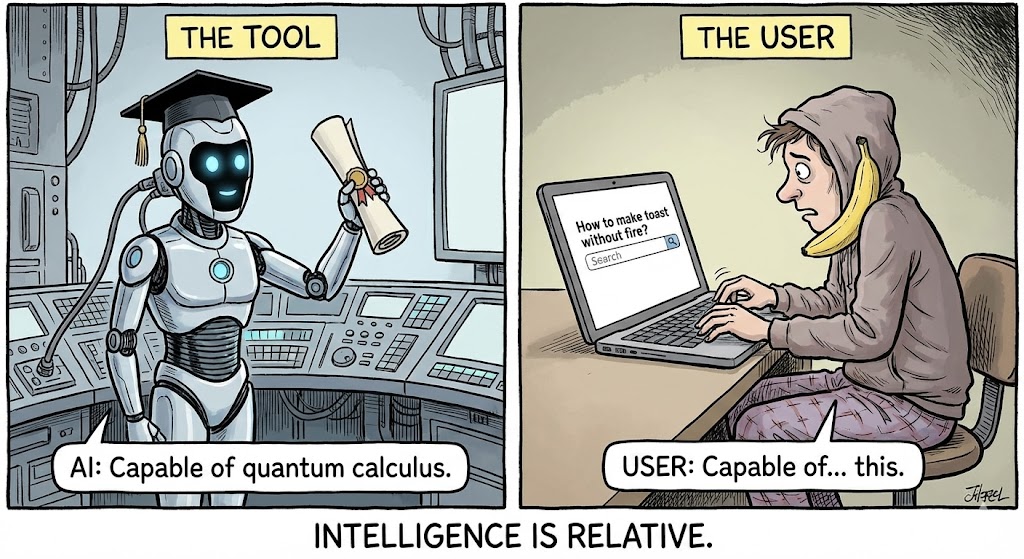
AI is not a magic wand that bestows competence on the incompetent. It is a Force Multiplier. It amplifies the intelligence of the user. If you are a brilliant architect, AI makes you a god. If you are a mediocre “ticket taker” who just patches bugs, AI makes you obsolete.
We are witnessing the end of the “Code Monkey” era, the collapse of the Global Labor Arbitrage model, and the rise of a new corporate metric: Profit-Per-Employee.
1. From “Specialist” to “God-Tier Generalist”
For the last decade, we fetishized hyper-specialization. We broke engineers into tiny fragments: “React Frontend Developers,” “Postgres DB Admins,” “DevOps Engineers.”
This fragmentation created a massive Inefficiency Tax. A simple feature required a meeting between the Frontend guy, the Backend guy, and the DB guy. It required a Project Manager to coordinate them. It required a Jira board to track them.
But in the Vibecoding era, the Specialist isn’t just dying—they are evolving.
The AI removes the barrier of Syntax. The Backend Engineer no longer needs to memorize CSS flexbox rules; the AI handles that. This allows a high-competence engineer to escape their silo. They are no longer just a violinist; they are the conductor and the entire orchestra.
“Specialization is for insects.” — Robert Heinlein
If you are a developer who defines your value by “knowing React” rather than “solving business problems,” you are in trouble. The syntax is free. The value has shifted entirely to System Architecture, Data Modeling, and Taste.
2. The Death of Human Middleware (Baumol’s Cost Disease)
The casualties won’t just be engineers. The “Non-Technical Middle Manager” is walking dead.
This is an economic phenomenon known as Baumol’s Cost Disease. Usually, this theory explains why services (like education) get more expensive while goods (like TVs) get cheaper. In Tech, the “Good” (Code) is dropping to zero cost. The “Service” (Management) remains expensive. The market will correct this imbalance by eliminating the management layer entirely.
The Non-Technical Product Manager
We all know the type. The PM who is a “Domain Expert” but doesn’t understand how the sausage is made. They write vague user stories like “As a user, I want the dashboard to load faster,” and then they wait for Engineering to tell them if it’s possible.
In an AI world, this PM is useless. Why? Because you cannot prompt an AI if you don’t understand the architecture. If you ask an AI agent to “build a dashboard,” it will build garbage. You need to tell it: “Build a React dashboard using Recharts, pulling from the Snowflake API, caching via Redis to reduce latency."
The End of the SDR and Onboarding Manager
- Sales Development Reps (SDRs): The job of sending 100 generic emails a day is dead. An AI agent can send 10,000 hyper-personalized emails, read the responses, and book the meeting. The “Volume Game” belongs to bots now.
- Customer Success: Why are we paying humans to teach other humans how to use software? AI agents will guide users through the product in real-time. The “Onboarding Manager” reading from a script is redundant.
3. The Economics of Labor Arbitrage (Ronald Coase & The Transaction Cost)
This brings us to the most uncomfortable reality: The collapse of the Outsourcing Model.
For 20 years, the software industry relied on Labor Arbitrage. The math was simple:
- The US Reality: An engineer in San Francisco costs $200,000.
- The Offshore Reality: An engineer in Bangalore costs $30,000.
- The Arbitrage: You hire the offshore team. Even if they are slower, the price difference is so massive you tolerate the inefficiency.
AI breaks the arbitrage math.
We can explain this using Ronald Coase’s Theory of the Firm. Coase argued that firms exist to reduce Transaction Costs (search, coordination, contracting). Outsourcing increases transaction costs (communication latency, cultural context, quality control), but low wages offset it.
AI is a massive deflationary force that eliminates the transaction costs.
- Old Math: 1 Hired Engineer ($200k) vs. 5 Offshore Engineers ($200k).
- New Math: 1 Hired Engineer + AI ($300k) = 10x Output.
Suddenly, the single US engineer is more productive than the team of 5, but without the Transaction Costs—no timezone delays, no language barriers, no “Project Manager” layer.
“The most expensive thing in software is communication. If you can eliminate the need to communicate by having one person do the work of ten, you win.” — Naval Ravikant
The “Managed Services” model (Infosys, Wipro) is the next Blockbuster. They sell “seats” and “man-hours” for maintenance and testing. But AI does maintenance and testing instantly for free. If your business model depends on billing hours for work that requires little creativity, you are technically a “human API,” and you are about to be deprecated.
4. The New Scoreboard: Profit-Per-Employee (PPE)
Because of this, the metric for success is flipping. For decades, founders like Founder A measured their worth by the size of their “Empire” (Headcount). “We just crossed 100 employees!” was a badge of honor.
In the AI era, Headcount is a liability. The smart money is watching Revenue-Per-Employee (RPE).
- Legacy SaaS Co (Founder A): $3M ARR / 80 Employees = **$37,500 RPE**.
- Status: Burning cash. Heavy management tax. Slow velocity.
- AI-Native Co (Founder B): $3M ARR / 3 Employees = **$1,000,000 RPE**.
- Status: Massive cash flow. Zero middle management. High velocity.
The AI-Native company can undercut the Legacy company on price by 50% and still be more profitable. They can spend 10x more on customer acquisition.
The “Throwing Bodies at the Problem” Fallacy (Brooks’s Law)
Legacy companies are addicted to Linear Scaling. When a problem arises (e.g., “Support tickets are piling up”), their reflex is to treat it like a manufacturing problem: Throw more bodies at it.
Step 1: Hire 20 more support agents.
Step 2: Realize 20 people create chaos.
Step 3: Hire 2 Managers to manage them.
Step 4: Hire a Director to manage the Managers.
You just built a pyramid of human routers.
This triggers Brooks’s Law: “Adding manpower to a late software project makes it later." In business terms, this is Diseconomies of Scale. Each new human adds “Communication Overhead.” As you add people, the complexity of the network increases exponentially (N(N−1)/2), slowing down decision-making.
This is Organizational Debt. Just like technical debt, you are borrowing against future speed to solve a problem today with the wrong tool (humans).
In the AI era, this is suicidal. When that same problem arises in an AI-native company, they don’t open a job requisition. The Full-Stack Engineer fine-tunes an LLM on the last 10,000 tickets.
- Cost: $50 in compute.
- Time: 2 hours.
- Headcount Added: Zero.
- Result: The AI-native company scales exponentially (Software economics), while the Legacy company scales linearly (Service economics). The Legacy company will eventually be crushed by its own weight.
5. The Pivot: If Building is Free, What Do We Sell? (Liability-as-a-Service)
This leads us to the existential crisis facing the software industry. We are rapidly approaching a zero-marginal-cost reality for code generation. If a small team—or even a single “non-technical” founder—can prompt an AI agent to “vibecode” a functional Salesforce clone in a weekend, the fundamental value proposition of SaaS is shattered.
Why would an enterprise customer pay Salesforce $300 per seat/month for software that a college student just replicated on their laptop for the cost of an API token?
The answer lies in a shift from Capability to Accountability. The answer is Trust.
We are leaving the era of Software-as-a-Service (SaaS) and entering the era of Liability-as-a-Service (LaaS).
The Code is a Commodity; The Shield is the Product
In this new paradigm, the ability to write code is table stakes. It is abundant, cheap, and accessible. You can direct an AI to build a payroll application in 48 hours. It will have a sleek UI, it will connect to bank APIs, and it will run perfectly… until it doesn’t.
The “product” is no longer the software functioning correctly when things go right; the product is what happens when things go wrong.
- The Payroll Scenario: Imagine you use a custom, AI-generated payroll script. It works for six months. Then, the AI “hallucinates” during a routine update—perhaps misinterpreting a new state tax code—and fails to withhold taxes for 500 employees. The Result? You, the employer, are liable. The IRS does not care that your AI hallucinated. You face audit penalties, lawsuits from employees for back-taxes, and potentially jail time for gross negligence.
- The Workday Scenario: Conversely, when an enterprise pays Workday or ADP millions of dollars, they are not paying for the SQL database that stores employee names. They are buying an insurance policy. If Workday glitches and messes up tax withholdings, Workday pays the fine. Workday deploys an army of lawyers and accountants to fix it.
The “Throat to Choke”
For the Fortune 500, software purchasing decisions are driven by risk mitigation, not just feature acquisition. This brings us to the concept of the “Throat to Choke."
In corporate governance, there is a massive premium placed on shifting blame. If a CIO buys a custom AI solution from a nimble startup and it causes a data breach, the CIO is fired for recklessness. If the CIO buys Microsoft or Oracle and the same breach happens, it is considered an “unfortunate vendor incident.” The CIO keeps their job because they made the “safe” choice.
Real-World Example: The CrowdStrike Outage
Consider the massive CrowdStrike outage of 2024. When a faulty update crashed millions of computers globally, it cost Delta Airlines alone over $500 million.
- Scenario A (The Startup): If that update had come from a cheap, AI-generated endpoint protection tool, Delta would have had no recourse. The startup would have simply declared bankruptcy, leaving Delta with the bill.
- Scenario B (The Incumbent): Because it was CrowdStrike, a massive public entity, Delta had a target for litigation. The “product” CrowdStrike sells is not just antivirus; it is the capital reserves and insurance policies required to absorb the shock of failure.
The Moat of the Legacy Dinosaur
The “Moat” for legacy giants—the Salesforces, SAPs, and Epics of the world—is no longer their source code. Their code is often legacy spaghetti that is worse than what an AI could write today.
“Trust is the coin of the realm.” — George Shultz
Their moat is their Indemnity Shield.
- SOC2 & ISO Compliance: These are grueling, expensive, human-centric auditing processes that prove a company handles data safely. An AI agent cannot “vibecode” a SOC2 Type II audit report.
- Regulatory Navigation: In healthcare (HIPAA) or finance (PCI-DSS/GDPR), the software must adhere to laws that change frequently. Legacy giants have armies of humans monitoring regulatory changes to update the compliance layer of the software.
- Financial Backstop: Enterprises buy software to offload risk. They pay a premium for the legal guarantee that if something breaks, it’s not the CTO’s fault.
The New Bifurcation
This creates a clear split in the market:
| The Micro-Enterprise (Speedboats) | The Legacy Giant (Tankers) |
|---|---|
| Sells: Innovation, Speed, Customization | Sells: Stability, Compliance, Indemnity |
| User: Startups, Creators, SMBs | User: Governments, Banks, Hospitals |
| Value Prop: “We solve the problem fast.” | Value Prop: “We are the Throat to Choke.” |
Conclusion: Don’t Build an Empire, Build a Fortress
To the founders reading this: Stop trying to hire your way to success. Stop measuring your self-worth by the size of your All-Hands meeting.
In the previous era, we built Empires. We hired armies of humans because human labor was the only way to scale output. An Empire is impressive to look at, but it is cognitively fragmented. Intelligence is fragmented across hundreds of nodes (people), slowing down the collective brainpower to the speed of a calendar invite.
In the AI era, you must build a Fortress.
A Fortress isn’t just about automation; it’s about concentrated intelligence. It is not defined by how many hands are typing, but by the clarity of the mind directing them.
The difference is physics.
- The Empire operates on Distributed Intelligence. It relies on the consensus of the many, moving at the speed of biology (meetings, emails, persuasion).
- The Fortress operates on Amplified Intelligence. It relies on the judgment of the few, amplified by silicon, moving at the speed of thought.
The Tale of Two Futures
Let’s go back to those two founders one last time.
Founder A (The Empire) is currently in a 4-hour “strategy offsite” in Singapore. He is mediating a dispute between his VP of Product and his VP of Engineering about “roadmap alignment,” while his offshore team in Bangalore waits 12 hours for instructions. He is burning $400k a month to generate $3M in value. He feels important, but he is actually just a high-paid babysitter for a bloated organization.
Founder B (The Fortress) is at the beach. She isn’t checking Slack because there is no Slack. Her agents are executing the strategy she designed last week. She isn’t working in the machine; she is designing the machine. She is burning $40k a month to generate the same $3M in value.
The Reality Check
The market is about to run a ruthlessly efficient garbage collection algorithm on the tech sector.
For the last ten years, we confused “Headcount” with “Brainpower.” We thought that if we hired 100 mediocre engineers, we would get the output of 10 geniuses. We were wrong. We just got 100 times the complexity.
The next Amazon or Google will not have 100,000 employees. It might not even have 1,000. It will be a small, terrifyingly efficient Fortress of “God-Tier” Generalists using AI not just to write code, but to simulate futures, predict risks, and execute decisions instantly.
In the future, there are only two roles left:
- The Architect who provides the judgment.
- The Artifact that executes the work.
The asteroid is already here. Stop building for the dinosaurs.