
Impact of AI on Management Jobs, Role Descriptions and Your Whole Existence Till Date in Tech Industry
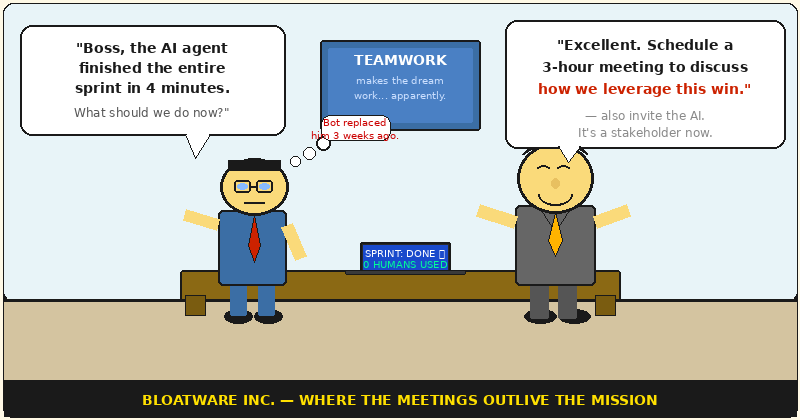
DISCLAIMER FOR THE SENSITIVE SOULS
If you are a manager whose primary skill is “facilitating a sync,” or “getting the work done”, please stop reading now. The following content contains high doses of reality that may cause your LinkedIn “Top Voice” badge to spontaneously combust. No “synergy” was harmed in the writing of this article, mostly because synergy isn’t real. If you find yourself offended, you are likely part of the “Commodity” layer, the group that does tasks an agent can do. My advice? Find a mirror, have a stern talk with yourself, and learn how to actually build something. Using ChatGPT or Gemini does not make you an AI expert any more than using Google in 2005 made you a research scholar. Also, the mention of “Handa Uncle” in the end of the article is to suggest an exit path to such managers and is not a promotion of Handa Uncle.
The Ghost of Bloatware Inc.: A B2B Horror Story
Consider Bloatware Inc., a B2B tech firm that, in 2022, boasted 500 employees. Their hallways were filled with “human routers”, people whose entire professional existence was taking information from one meeting and moving it to another.
-
The Product “Scribes”: PMs spent 40 hours a week writing Product Requirement Documents (PRDs) that served as paperweights while they waited weeks for a developer to look at them.
-
The Manual QA Ritual: A department dedicated to clicking buttons to see if they broke a process as efficient as a sundial in a thunderstorm.
-
The Professional Chasers: Scrum Masters, Delivery Leads, and Project Managers whose primary tool was a “stick” to track hours rather than output.
-
The Support Functions: HR and Finance departments filled with “human OS bugs,” spending time on manual payroll, onboarding, and expense reports.
By 2026, Bloatware Inc. didn’t have 500 employees; it had 50. The work didn’t vanish; the “routers” did. This followed a brutal industry trend where tech layoffs surged to 1,170,000 globally by 2026 as companies finally realized that coordination is now a solved problem.
Leadership: The “Prompt Master” Delusion
Leadership today is often a victim of the Dunning-Kruger Effect: when confidence consistently exceeds competence. Many executives believe that because they can type a prompt into a chatbot, they are now “AI Experts”. This is a trap. AI makes everyone feel like an expert after a two-minute chat, but a two-minute answer does not equal domain expertise.
In the previous era, Executive Mode meant scaling through headcount and bureaucracy. In the Agentic Age, it means scaling through decision quality and agentic leverage. Andy Grove, the legendary leader of Intel, warned that success breeds complacency. He identified “strategic inflection points”, times when the fundamentals of a business change so much that the old strategy becomes a path to death.
The stars of the previous era, the ones most comfortable in the old system are the ones most likely to be destroyed. Amazon alone cut 14,000 corporate roles in middle management to redirect billions into AI infrastructure. If your “leadership” is just tracking headcount and asking for slide decks, your job has already been automated by a script that can rank ROI better than you can.
“A strategic inflection point is a time in the life of a business when its fundamentals are about to change." — Andy Grove.
Product Management: From Scribe to Architect
The tech industry has survived several inflection points: the Dot-com era (web pages), the Mobile era (phones), and the Cloud era (rented power). In each wave, those who refused to touch the new tools became relics. The managers at Blackberry are the classic example; CEO Thorsten Heins focused on tracking hours while Apple was making the phone a remote control for life. Heins collected a $22 million payoff while his company went to zero.
At Bloatware Inc., the PM job was the first to be “AI-washed”.
-
The Commodity (Doing): Writing specs, meeting summaries, and basic data analysis.
-
The Premium (Deciding): Strategic discovery, architecture trade-offs, and high-stakes diplomacy.
The surviving PMs became “Hands-on Architects”. They use Linear to rank backlogs objectively, removing office politics and doing in 45 minutes what used to take 16 hours. They use Cursor to read entire codebases and Replit Agent to build working 3-screen prototypes on a Saturday morning to show users on Monday.
| Old World Focus | Agentic Age Focus |
|---|---|
| Writing long PRDs and requirement specs | Managing a fleet of coding agents and architecture |
| Coordination between engineering and stakeholders | Strategic discovery and architecture trade-offs |
| Building roadmaps manually | Using AI to interpret distilled feedback from millions |
If you can’t define a software architecture or a high-level technical design while working with AI, you are a dinosaur watching the asteroid hit.
“It’s got cobalt, nickel, aluminium, carbon… break that down on a material basis… you just need to think of clever ways to take those materials and combine them." — Elon Musk (on First Principles).
The Death of the “Routers”: Scrum, Project Managers, and the Delivery Bloat
The traditional architecture of software delivery has long been plagued by what veteran builders call “Bureaucratic Friction”. This friction is personified by a layer of roles like Project Managers, Scrum Masters, Customer Success Managers (CSMs), and Delivery Managers who functioned as “human routers”. Their entire professional existence was predicated on taking information from one meeting and moving it to another, a cycle of “facilitating a sync” or “getting the work done” that added zero material value to the product itself.
In the previous era, a manager derived leverage from the ability to coordinate ten people. Today, that leverage is a relic. An expert now derives leverage by coordinating ten thousand agents. When AI agents like Devin or Copilot Workspace can execute entire sprints autonomously, the bottleneck shifts from the speed of “chasing” status to the quality of high-level decisions. The assumption that “getting the work done” involves chasing people with a stick is dead; coordination is now a solved problem.
The Assumption of Action vs. The Reality of Theater
These “router” roles often operate under the delusion that their frantic activity equals output. However, as noted in the veteran view, you are not paid to be smart or to “manage the process”; you are paid for what the team actually ships.
- Project Managers: Spent forty hours a week on status updates that tools like Linear now handle in minutes.
- Delivery Managers: Focused on helping “groom the backlog” and manual Gantt charts, tasks that AI now ranks objectively based on data, stripping away the office politics.
- Customer Success Managers: Acted as “professional apologizers” for bugs they didn’t understand or “representing the customers’ voice”, while AI now synthesizes million-user feedback loops instantly.
The Cost of “Chasing”
These roles represent a massive cost to the company, eating out revenue and keeping margins low often dragging a software company’s 80% margins down to a pathetic 25%. This is the “Commodity” layer. If a job is about doing tasks an agent can do, such as tracking timelines or “checking in,” it has a deadline. If your Directly Responsible Individual (DRI) is just a “timeline chaser” who tracks hours like the former Blackberry CEO Thorsten Heins, they are a biological bottleneck.
Historical data proves the systematic purging of this class. Major players like Amazon cut 14,000 corporate roles in middle management alone to redirect billions into AI infrastructure. This restructuring follows the warning that “only the paranoid survive”; those who are most comfortable in the current “coordination” system are the ones most likely to be destroyed by the next strategic inflection point.
The survivors are the “Architects”, the people who define the problem before touching the tools. If you aren’t providing strategic discovery or high-stakes diplomacy, you are just tactical noise in an increasingly silent, efficient machine.
This shift is a modern application of Moore’s Law to management: if the ability of AI to perform a task doubles every year while the cost drops, the human “task manager” becomes an expensive relic. Layoff data shows a massive restructuring:
-
2023: 260,000+ layoffs (initial post-pandemic correction).
-
2024: 190,000+ layoffs (start of the “efficiency” movement).
-
2025: 450,000+ layoffs (AI begins replacing routine roles).
-
2026: 1,170,000+ layoffs hit as companies fully restructured toward agentic AI.
“Stop optimizing non-bottlenecks. Every hour spent there is pure theater." — Eliyahu Goldratt.
Sales and Marketing: The SDR Guillotine
Marketing at the old version of companies like Bloatware Inc. was essentially a high-priced content mill. It was a world of “participation trophies” where ten people were paid to write blog posts that precisely zero humans ever read, while another five spent forty hours a week arguing over the hex code of a social media graphic. When the agentic AI asteroid hit, these teams were not just “downsized”, they were evaporated and replaced by a single Growth Architect.
This architect doesn’t “manage a creative process” because agents are objectively better at creative testing. They use agents to generate thousands of variations of an ad and run autonomous experiments to see which one actually converts. If you are a Marketing leader who cannot build your own automations and instead relies on “requesting” things from engineering, you are currently standing on a trapdoor.
The Sales department is facing an even more hilarious reckoning. For years, tech sales has been a game of “Human Routers” disguised as SDRs and Account Executives. Their primary skill? Sending “just checking in” emails and finding leads, tasks that are now handled by agents with 100% efficiency and 0% need for a commission check. By 2025, the industry saw 450,000+ layoffs as companies realized that a human sending ten manual emails a day is a massive waste of capital compared to an agent doing it for free.
The most brutal truth? If a salesperson needs a Product Manager to join every meeting just to explain how the software works, that salesperson is not actually “selling”, they are a Commercial Officer whose only value is negotiating a price and then calling the CEO to approve a bad deal with “loads of customizations”. If you cannot build a basic prototype using tools like Cursor or Replit Agent to get customer buy-in on the fly, you are a biological bottleneck in the sales cycle.
The new “material constituents” of sales are not “patter” and “persuasion,” but technical expertise and High Agency. The only salespeople left are those capable of high-stakes diplomacy and building real human relationships. If you don’t understand the tech behind what you sell, you will be replaced by an agent that does and that agent won’t demand a President’s Club trip to Hawaii for doing its job.
HR and Finance (The Exorcism of Human OS Bugs)
Historically, the back office has been the sanctuary of the “Human OS Bug”, a term used by veterans to describe the catastrophic inefficiency of manual, high-friction workflows. HR and Finance departments have often functioned as black holes of productivity, where time goes to die in a flurry of expense reports, payroll spreadsheets, and the same repetitive questions about holiday policies. In the previous era, these roles were tolerated as necessary “overhead,” but in the current age, they are being exposed as a “Commodity” layer with a rapidly approaching shelf life.
The Current Collapse of “Paper-Pushing”
The impact on these roles is not a future threat; it is a current restructuring. Agentic tools are already executing multi-step workflows that once required entire sub-departments.
- Instantaneous Data Synchronization: AI tools now sync name changes, tax status updates, and benefit adjustments across payroll and tax records instantly. This removes the need for “human routers” who spent their days taking information from one form and typing it into another.
- Handling Localized Complexity: In regions like India, AI is being leveraged to navigate the nightmare fuel of state-specific labor rules and complex TDS (Tax Deducted at Source) calculations. This has made manual payroll processing not only slower but also a financial liability due to the higher error rate of humans compared to automated systems.
- The Cost of “Doing” vs. “Deciding”: The industry is actively shifting toward a model where one human plus AI equals an entire department. If a job consists of tasks that can be explained in a simple manual, such as basic reporting or data entry, it is being automated out of existence.
The Rise of the “Culture Debuggers”
Those who remain in these departments have stopped “managing paperwork” and have started “debugging humans”.
- Predictive Sentiment Forensics: HR professionals are now using AI to analyze employee sentiment and identify churn patterns before they manifest as resignations.
- Intuition-Led Intervention: While the AI provides the pattern recognition, the human professional uses intuition to fix the cultural rot. They understand that culture is the company’s operating system, and if the human OS is buggy, no amount of clever code will save the business.
The End of “Proxy Hell”
For years, back-office leadership optimized for “Participation Trophies”—vanity metrics like meeting counts and NPS scores that measured politeness rather than actual loyalty or output.
Today, these leaders are being judged by Actionable Metrics such as Time-to-Value and K-Factor. If a back-office leader cannot build their own basic automations and instead relies on the engineering team to do their “how,” they are viewed as a biological bottleneck.
The FIRE Option: Adapt or Retire (The “Get Out of the Way” Strategy)
As the corporate world undergoes a “software update for the human race,” a new trend has emerged for the seasoned veterans who find themselves increasingly confused by tools that don’t require a “sync meeting” to operate. This is the FIRE movement (Financial Independence, Retire Early), and in 2026, it is less of a lifestyle choice and more of a strategic exit for those who have realized they are the biological equivalent of a floppy disk in a cloud-computing world.
If you are fifty or older, still insisting that “we need more eyes on this,” and your personal finances are actually in order, it might be time to stop “managing” and start “departing”. In India, the patron saint of this movement is Ravi Handa (famously known as Handa Uncle), who famously retired with a corpus of 12 crore rupees after his edtech startup was acquired. His message is brutally honest: your career is your business, and you are its only employee. Nobody owes you a career, and certainly, no AI agent is going to wait for you to finish your artisanal coffee before it executes a full sprint autonomously.
If you are a middle manager today who lacks “hands-on” skills and your only moat is a clever set of slides, your best move is to consult the Handa Uncle AI tool. This tool is a perfect example of a veteran using expertise to build something useful rather than just managing a team. It will help you calculate your retirement number so you can get out of the way of the “Architects” who actually know how to use Cursor.
“Achieving FIRE brings freedom… but it also brings a lack of structure that many corporate people can’t handle. If your life has always been governed by meetings and deadlines, having zero obligations can lead to chaos."
For those who have a deep passion for “aligning stakeholders,” FIRE is the ultimate exit path from a corporate world being eaten by agents. Whether it is fitness, travel, or building your own tools, the goal is to exit before the “Chief-Bot-9000” reviews your output and realizes that removing you increases team velocity by 65%. In the era of the Directly Responsible Individual (DRI), the only person you truly need to manage is yourself. So, loosen your tie, check your carbon credits, and remember: the shortest ego-to-pivot ratio wins, even if that pivot is toward a beach in Goa.
The Strategy Room: The Exit Interview
The board room at Bloatware Inc. was quiet, but it was not empty. Arthur, the former “VP of Organizational Synergy,” was gone: last seen typing his numbers into the Handa Uncle app and realizing he had enough carbon credits to move to a smaller city.
In his place sat a small group of Architects. They were not “managing” anyone. One was a Product Lead who had just finished a live prototype in Cursor to show a $50M client. Another was a “Culture Debugger” who had used AI to identify a burnout pattern in the engineering fleet before it became a churn problem.
“The agents say we can ship the new module by Tuesday,” the Finance Lead said, looking at a Linear dashboard that had objectively ranked the technical debt.
“No,” the Product Lead replied. “We pivot. I have been looking at the feedback synthesized by Claude. They do not want more features. They want simplicity. I have already architected the trade-offs and defined the high-level design. We do not need a sync meeting to align the stakeholders. I have already sent them the proto-link.”
Outside, a junior PM was watching an agent execute a full sprint autonomously. He was not worried about his job. He was busy learning how to decide what to build next. The strategic inflection point had passed. The stars of the new era were not the ones who could talk: they were the ones who could do.