
Rearchitecting DOOH: Moving From Expensive Wallpaper to Agentic Decision Engines (Post CES 2026 Effect)
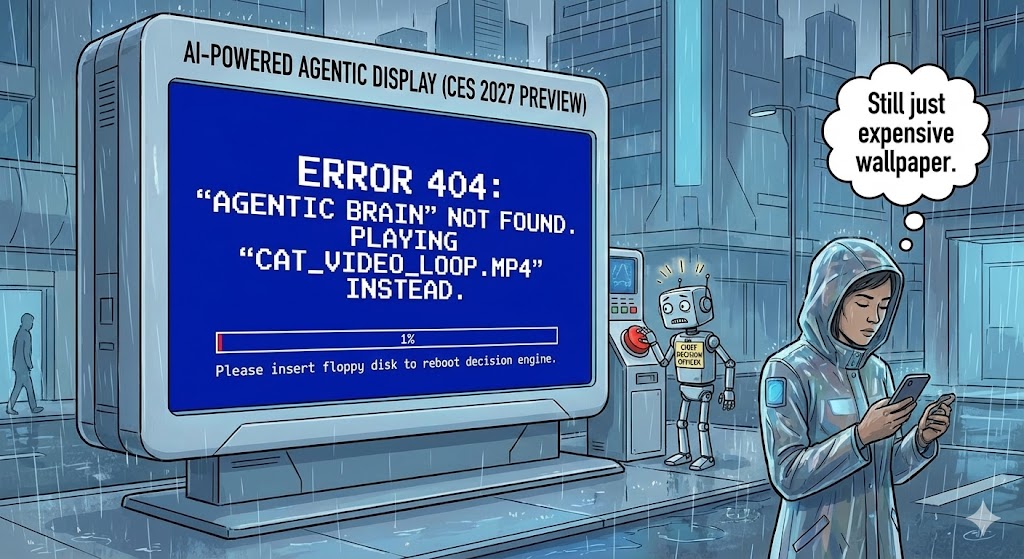
The Epilogue to the Rainy Tuesday: 2027 Edition
Let’s fast forward to that same rainy Tuesday in November 2027. The bus shelter hasn’t moved, but the brain inside it has been lobotomized and replaced.
The rain starts falling. The crowd gathers. This time, the screen doesn’t play a perfume ad. It doesn’t play a loop. The screen goes dark for 20 milliseconds—a “Headless” reset triggered by an edge signal. Then, a bright, high-contrast creative appears: “Uber Surge Pricing Waived for Next 15 Mins from this Stop. Scan to Unlock.”
The crowd doesn’t ignore it. They attack it. QR codes are scanned. Rides are booked. The Advertiser (Uber) just paid $60 CPM and smiled about it because their Return on Ad Spend (ROAS) was calculated in real-time. The Media Owner just made more in 15 minutes than they usually make in a day.
The Consumer got home dry.
In my last article, Why DOOH Brought a Knife to the CES 2026 Gunfight: The 12-Month Roadmap to a ‘Minority Report’ Reality for CES 2027. I argued that our industry is failing because we rely on static loops and spreadsheet math. And in this linkedin post about the same, many senior leaders of DOOH and adtech industry commented about loops, measurement and attribution issues in DOOH
Now that CES 2026 is over with all agentic AI discussions and along with the response and messages in context of my previous post, I was itching to write more on this topic and it also seemed like everyone was asking me the same question: “Okay, smart guy. You told us we’re holding a knife. How do we actually build the gun?”
And the first thing that I want to say is: We don’t need more “digital transformation” fluff. We don’t need another panel on “The Future of OOH” where four people agree that “data is important.” We need a systems architecture.
We need to stop building Video Players, CMS Connectors, Creative Management Tools etc and start building Decision Engines.
As Jensen Huang, CEO of NVIDIA, (paraphrasing) said in his keynote just three days ago at CES 2026:
“We have moved past the era of ‘smart’ devices. We are now in the era of ‘Agentic’ devices. If your hardware cannot negotiate its own value in real-time, it is already obsolete."
Your digital billboard is obsolete. It’s a dumb terminal waiting for orders. Here is the 5-step technical roadmap to lobotomize that dumb screen and give it an Agentic Brain by CES 2027.
Introducing Ad Pod in DOOH: Move Ad Decisioning to the Edge
The Paradigm: From “Winner Takes All” to “Unified Yield.”
The biggest lie in Programmatic DOOH is the “Unified Auction.” In reality, most Media Owners run a “Waterfall.” They check their Direct Sold schedule, then check one SSP, then another. This is inefficient and technically flawed.
The solution is the OpenRTB 2.6 Structured Ad Pod.
The Technical Architecture (Multi-DSP Scenario)
In Connected TV (CTV), a “Pod” is a commercial break. In DOOH, we must treat every availability window (or that ill-conceived “loop”) as a Pod.
The Workflow:
- The Trigger: The screen signals it has a 60-second avail.
- The Request: The Supply Side Platform (SSP) sends out a Pod Request to 5 different DSPs (The Trade Desk, DV360, Yahoo, etc.).
- The Response:
- DSP A bids $20 for a 15s slot (Nike).
- DSP B bids $35 for a 10s slot (Uber).
- DSP C bids $5 for a 30s slot (Local Lawyer).
- The Stitching (The Edge Logic):
Here is where the magic happens. The Media Owner’s Ad Server (running on the Edge, not the Cloud) receives these bids. It does not just pick the highest price. It runs a Knapsack Algorithm to maximize Yield per Second.- Option 1: Play DSP C (30s @ $5). Total: $5.
- Option 2: Play DSP A + DSP B (25s @ $55). Total: $55.
The Transparency Gain: Currently, DSPs blindly buy slots and pray they don’t run next to a competitor. In the Ad Pod model, the Media Owner’s Ad Server constructs the pod and sends back a “Pod Composition” signal.
- To DSP A: “You won Slot 1. Slot 2 is Uber. Slot 3 is Weather.”
- To DSP B: “You won Slot 2. Slot 1 was Nike.”
This transparency allows DSPs to bid more confidently. A luxury brand might bid 2x more if they know (cryptographically guaranteed) that the ad playing before them is High-End Fashion and not a Personal Injury Lawyer.
The Playback Shift: Why SSAI is the Only Way Forward
The Paradigm: From “File Download” to “Live Stream.”
Currently, 90% of DOOH failures happen because we ask a $200 Android box to do a $2,000 job. We ask it to download heavy creative files (4K ProRes), manage schedules, parse VAST tags, and handle proof-of-play logs locally. When it runs out of memory, you get a black screen (or worse, the Windows desktop).
Anthony Wood, CEO of Roku, proved this model in the living room years ago:
“The TV operating system is the new battleground. It’s not about the screen; it’s about the software delivering the stream."
The 2027 Fix: Server-Side Ad Insertion (SSAI)
We must adopt the “Headless” model used by Netflix and Roku.
The Technical Stack
- The Device is Dumb: The media player on the street is stripped of all logic. It does not “play files.” It opens a single HLS (HTTP Live Streaming) or DASH stream from the cloud. It is a dumb rendering pipe.
- The Edge is Smart: The decision logic moves to Edge Compute nodes (think Fastly or AWS Wavelength). The cloud stitches the content (weather, news) and the ads into a linear stream in real-time using a Just-in-Time (JIT) Transcoder.
- The Seamless Stitch: The HLS manifest is updated dynamically. The player just sees a continuous stream of video segments (.ts files).
The Business Case for SSAI
- Cost Saving (CapEx): You no longer need expensive Intel NUCs or high-end media players. You can run a 4K stream on a $35 Raspberry Pi or a Tizen chip embedded in the screen. You save millions in hardware refreshes.
- Revenue Increase (Latency): An Android box downloading a file takes 30-60 seconds to “ingest” a new ad. An SSAI stream can inject a new ad in 200 milliseconds. This unlocks “Real-Time Triggers” (like the Uber rain example) that are impossible with file-based systems.
The Attention Economy: CPAS (Cost Per Attention Second)
The Paradigm: From “Opportunity to See (OTS)” to “Cost Per Attention Second (CPAS).”
This is the most critical section. For decades, DOOH has relied on “fuzzy math”—selling impressions based on historical footfall averages. “We think 500 people passed by, so pay us for 500."
To move budgets from Meta and Amazon, we must move to Deterministic Science. We need to build a measurement stack that functions like a pharmaceutical trial.
The New Metric: CPAS
We stop counting “bodies.” We start counting Gaze. The industry needs to transition from selling the box to selling the time spent inside the box.
The Tech Stack (Sensor Fusion):
We deploy a sensor suite on the screen, combining Computer Vision (CV) and Depth Sensors (LiDAR).
- LiDAR: Creates a privacy-safe 3D point cloud of the crowd to count bodies and distance.
- Computer Vision: Analyzes the Gaze Vector. It calculates the angle of the head and eyes relative to the screen.
The Financial Algorithm:

The Business Model Shift:
We transition from CPM (Cost Per Thousand) to CPAS (Cost Per Attention Second).
- Scenario A (The Highway Billboard): 1,000 cars pass. 50 drivers glance. Average gaze is 0.5 seconds.
- Old Model: You charge for 1,000 impressions. (Fraudulent).
- New Model: You charge for 25 Attention Seconds. (Low Value).
- Scenario B (The Elevator Screen): 10 people ride. 8 people stare. Average gaze is 15 seconds (captive audience).
- Old Model: You charge for 10 impressions. (Undervalued).
- New Model: You charge for 120 Attention Seconds. (High Value).
This flips the economics. It allows DOOH to compete with TikTok, which also sells attention. If you are a CFO, wake up. We are giving away our most valuable asset—Sustained Attention—for free, bundled inside a generic “Impression.”
The Trust Shift: Cryptographic Proof of Play
The Paradigm: From “Log Files” to “Digital Signatures.”
The biggest blocker to DOOH spend is trust. Did the ad actually play? Is the screen actually there? Did the player crash halfway through?
Currently, we send “Proof of Play” (PoP) logs. These are text files. They can be edited. They can be faked. They are worthless.
The Fix: Device Attestation & TPM
We need to borrow security protocols from the Fintech world.
The Technical Workflow
- The Hardware Root of Trust: Every media player must have a Trusted Platform Module (TPM) or a Secure Enclave (like in your iPhone). This chip contains a private cryptographic key that cannot be extracted.
- The Signed Heartbeat: Every 5 seconds, the player generates a “Heartbeat” signal containing:
- Timestamp
- GPS Coordinates
- Hash of the Frame currently on screen
- The Signature: The TPM signs this heartbeat with its private key.
- The Verification: The Advertiser receives this signed packet. They use the Public Key to verify it.
- If the signature matches: It is mathematically impossible for the log to be faked. The ad must have played on that specific device.
Brian O’Kelley, CEO of Scope3, puts it bluntly regarding supply chain transparency:
“Waste is a design flaw. If we build systems that require redundant processing and inefficient delivery, we are just burning money and carbon."
Fraud is waste. Cryptography kills fraud. By 2027, if your PoP isn’t cryptographically signed, you aren’t getting paid.
The Attribution Shift: Closed Loop & Clean Rooms
The Paradigm: From “Fuzzy Attribution” to “Synthetic Control Groups.”
This is the endgame. The previous steps ensure the ad played and was seen. This step ensures it worked.
How do we know if the viewer bought the coffee? We bridge the gap between the Screen and the POS without tracking the user.
The Tech: Snowflake, InfoSum, or LiveRamp.
The Workflow:
- Publisher: Uploads “Exposed Environment” data (Time + Location + Device IDs hashed via Wi-Fi sniffers) to the Clean Room.
- Retailer (e.g., Walmart Connect): Uploads Point-of-Sale transaction data to the same Clean Room.
- The Match: The Clean Room runs an encrypted intersection. No PII (Personally Identifiable Information) ever leaves the room.
The Proof (Synthetic Control Groups):
We don’t need to track you. We need to track the difference.
- Methodology: The system automatically builds a “Synthetic Control Group”—a virtual audience that is statistically identical to the exposed audience but was not near the screen.
- The Result: “Viewers of Screen A had a 14% Incremental Lift in purchase probability compared to the Synthetic Control."
Kelly Gerrard, Director at Marshall (speaking on Retail Media in 2026):
“Some brands use ‘new-to-brand’ as a proxy for incrementality, but it’s not enough. By the end of 2026, if you can’t prove incremental lift via a clean room, you aren’t on the media plan."
This turns DOOH from a “Brand Awareness” channel into a “Point of Purchase” Performance Channel. We are literally the last screen a consumer sees before they buy. If we can’t attribute that sale via a Clean Room, we deserve to go out of business.
Closure: The Builder’s Manifesto
Let’s go back to that rainy Tuesday in November 2027.
The screen goes dark. The Agent negotiates. The Cloud stitches. The TPM signs. The Clean Room verifies. The screen lights up: “Uber Surge Pricing Waived. Scan Now.”
The Consumer gets a ride. The Advertiser gets a sale. The Media Owner gets rich.
We are standing at a bifurcation point. One path leads to us becoming “Landlords”—renting out glowing rectangles to whoever will pay the rent, slowly losing relevance to Retail Media Networks and Mobile. The other path leads to us becoming “Broadcasters”—owners of the most powerful, privacy-safe, high-attention medium on the planet.
This DOOH future won’t be built by people who are good at real estate or running traditional trading and arbitrage models. It will be built by engineers who understand Edge Compute, HLS Stitching, Clean Rooms, and Cryptographic Attestation.
We have the screens. We have the data. The “Gun” is just a stack of code waiting to be written. Who is ready to build it?