
The Annual Hunger Games : Appraisals Are Round The Corner! Get Ready !!
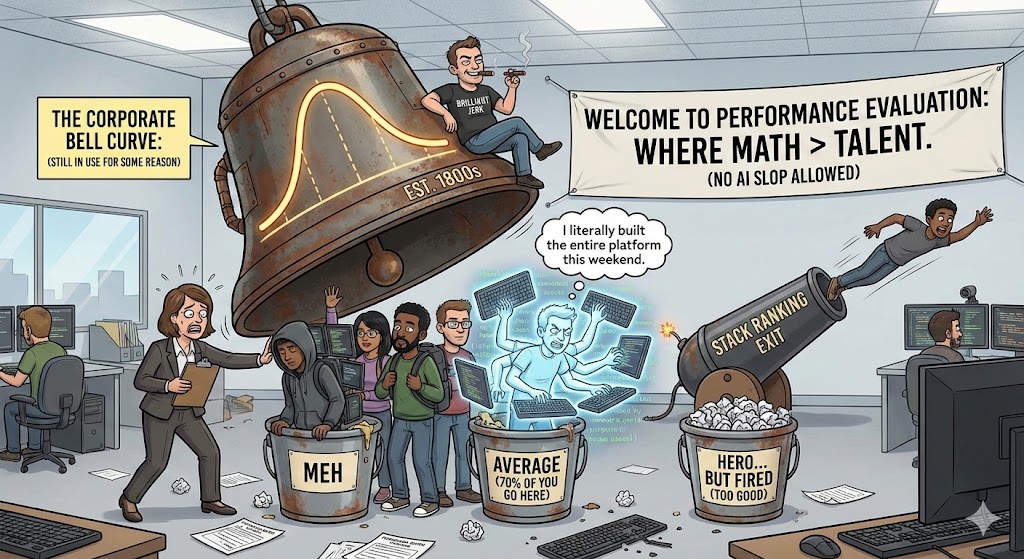
Lock your doors, hide your high-yield coffee beans, and delete your search history for “how to explain a 4% raise during 8% inflation.” It’s that magical time of year again: The Annual Appraisal Cycle.
Forget The Last of Us or Squid Game; those are rom-coms compared to the psychological warfare of the Corporate Finance Bell Curve. This is the time when your manager—who hasn’t seen a spreadsheet cell since the Obama administration—suddenly becomes a mathematical savant, hell-bent on proving that despite your 80-hour work weeks and “10x impact,” you are, statistically speaking, just “aggressively average.”
Welcome to the Corporate Hunger Games, where the Tribute from Accounting must fight the Tribute from Compliance over a single “Exceeds Expectations” slot that was actually promised to the CEO’s nephew three months ago.
Imagine you’ve just spent the last twelve months absolutely crushing it. You shipped the core API three weeks early, you mentored four juniors until they stopped crying in the breakroom, and you saved the company’s flagship product from a catastrophic security breach while the rest of the leadership team was at a “mindfulness retreat” in Bali.
You walk into your annual review feeling like a gladiator returning from a successful conquest. You’re ready for that “Exceeds Expectations” rating, a bonus that makes your mortgage look small, and a promotion that actually reflects your impact.
But as the door closes, the atmosphere shifts. Your manager, Dave—who has the spinal column of a chocolate eclair—won’t look you in the eye. He starts talking about “organizational health,” “budgetary constraints,” and “the broader talent distribution.”
Translation: The HR department just ran your career through a 200-year-old math equation, and you lost.
“Look,” Dave stammers, “You did an incredible job. Truly. But we already gave the ‘Exceeds’ rating to Sarah because she’s been here longer, and the system says only 10% of the team can be ‘Great.’ So, you’re officially ‘Solidly Meets Expectations.’ Here’s a 2% raise and a branded hoodie. Don’t spend it all at once.”
This is the Bell Curve. It is a mathematical mugging. It is the professional equivalent of telling a marathon runner they finished in “last place” because the race director decided that only three people are allowed to be fast today. It is the single most effective way to turn your best employees into your competitors' best employees by next Monday.
The Gaussian Ghost: A Brief History of Scientific Laziness
To understand why we are still stuck in this nightmare, we have to look at where it came from. The bell curve, or Normal Distribution, was popularized in the early 19th century by Carl Friedrich Gauss. He didn’t design it to measure software engineers or product leads; he used it to track errors in astronomical observations and the physical heights of French conscripts.
It was a way to measure accidents, errors, and static physical traits. It was never meant to measure human potential, creativity, or the non-linear impact of a knowledge worker.
Then came the 1980s. Jack Welch, the then-CEO of General Electric, decided that the best way to run a company was to treat it like a gladiatorial pit. He popularized “Rank and Yank” (also known as the “Vitality Curve”). You put 20% of your people in the top tier, 70% in the middle, and 10% at the bottom. Then, you fired the bottom 10%.
It worked for GE back then because they were an industrial conglomerate making lightbulbs and jet engines. In a factory setting, the difference between a “good” worker and a “bad” worker is marginal. If a guy on the assembly line is 10% faster, he’s a star.
But in the 21st century, we don’t manufacture lightbulbs; we manufacture ideas. And ideas do not follow a bell curve. By forcing a normal distribution on a high-performance team, you are effectively telling your overachievers that their hard work is statistically inconvenient.
The Myth and the Monster: The 10x Engineer
Whenever you criticize the bell curve, an HR “Thought Leader” (usually someone who has never written a line of code or closed a million-dollar deal) will pipe up: “But the 10x engineer is a myth! It’s all about the team!”
Let’s be brutally honest: People who say 10x engineers don’t exist are usually 1x engineers (or 0.5x “B-players”) who are terrified of being measured against them.
What is a 10x Engineer?
A 10x engineer isn’t someone who types ten times faster. They aren’t the ones staying until 2 AM every night to show how “busy” they are. In fact, a 10x engineer often looks like they’re doing less work.
The 1x engineer solves a problem by writing 2,000 lines of complex, brittle code. The 10x engineer spends three hours staring at a whiteboard, realizes the problem shouldn’t exist in the first place, deletes 500 lines of old code, and replaces the whole mess with a 10-line elegant script.
How to Identify Them:
- The Simplifiers: While everyone else is adding features, the 10x-er is removing friction.
- The Force Multipliers: They don’t just do their work; they build tools and systems that make everyone else on the team 2x better.
- The Outcome Obsessed: They don’t care about “Jira tickets closed.” They care about whether the user’s problem was actually solved.
In a bell curve system, the 10x engineer is an anomaly that HR tries to “average out.” But in reality, performance in the tech world follows a Power Law (Pareto Distribution). A tiny fraction of the people produces the vast majority of the value. Trying to put a 10x engineer on a bell curve is like trying to fit a skyscraper into a shoebox.
The Anatomy of the “Brilliant Jerk” (Netflix’s Warning)
The term “Brilliant Jerk” was Netflix’s gift to the world. A Brilliant Jerk is that person who is technically untouchable—the architect who can recite the entire kernel source code from memory—but who treats everyone else like cognitive peasants. They use their “brilliance” as a shield to bully colleagues, ignore processes, and create a “fear-based” environment.
Why the Bell Curve is Their Natural Habitat:
In a forced-ranking system, the Brilliant Jerk is safe. Why? Because the system only measures “Output.” The Jerk produces high output, so they get the “Exceeds” rating. Meanwhile, the five people they bullied into silence or sabotaged are placed in the “Average” bucket because their “productivity dropped.”
Netflix realized that the “Brilliance” of one jerk is never worth the collective productivity loss of the ten people they’ve demotivated. If you have a Brilliant Jerk, you don’t have a high-performer; you have a human dumpster fire with a high IQ. They should be fired immediately, regardless of how “critical” they claim to be.
The Hero Syndrome: A Saboteur with a Cape
We’ve all met the “Hero." This is the person who swoops in at 3 AM to fix a crashing server or the “Firefighter” who saves a failing account at the last second. The company gives them a plaque. The CEO mentions them in the All-Hands.
Here is the brutal truth: If that person has saved the company more than twice, they aren’t a hero—they are a liability.
Hero Syndrome is often a Brilliant Jerk in disguise. These individuals thrive on crisis. They build “black box” systems that only they understand. They don’t document their work. They subconsciously (or consciously) ensure that the company is constantly on fire so they can be the only one with a hose.
The Test: If your “Hero” goes on vacation and the company falls apart, they haven’t saved you; they’ve sabotaged you. A true 10x performer builds systems that don’t break and mentors others so they are never the single point of failure. If you have a “Hero” who has saved the day three times in a row, don’t give them a bonus. Fire them. They are preventing your company from becoming a professional organization.
The High Cost of the “Average” 80%
HR heads love the Bell Curve because it makes the budget predictable. “If we keep 80% of people in the ‘Average’ bucket, our salary growth remains flat. We’re saving money!”
Congratulations, you just spent $10 million to save $10,000.
A larger team of mediocre people is exponentially more expensive than a small team of superstars.
- Management Bloat: Mediocre people need managers. Managers need directors. Directors need VPs. Soon, you have six layers of people whose only job is to “coordinate” the lack of initiative.
- The Drag Effect: Mediocre people build mediocre products. They don’t innovate; they maintain.
- The Recruitment Death Spiral: Superstars want to work with other superstars. The moment a 10x engineer realizes they are being “curved” alongside a C-player, they leave. You are left with a company full of “average” people who are just happy to have a job.
The Hall of Fame: The Curve Killers
These are the companies that realized that humans aren’t data points and decided to treat talent like a scarce resource.
- Microsoft (The Satya Pivot): Under Steve Ballmer, Microsoft was the poster child for “Stack Ranking.” It turned the company into a circular firing squad. Engineers were more focused on sabotaging their deskmates than beating Apple. When Satya Nadella took over, he killed the curve. He replaced “competition” with “Growth Mindset.” The result? Microsoft’s stock price entered orbit.
- Stripe: They ignore the curve entirely. They evaluate based on Operating Principles. If you don’t meet the absolute bar of being a “Stripe-level” thinker, you don’t stay. They don’t care about buckets; they care about excellence.
- Netflix: The “Keeper Test.” No formal reviews. Just one question: “If this person wanted to leave, would I fight to keep them?" If not, they get a massive severance package. It’s the ultimate removal of mediocrity.
- Google & Meta: They use Absolute Evaluation. You are measured against the Impact you had on the business. If an entire team of 50 people has a “Redefining” year, Google pays all 50 of them like gods. They understand that talent is a Power Law, not a bell.
The Hall of Shame: The Jurassic Relics
- The “Big Four” Consulting Firms (Deloitte, KPMG, PwC, EY): They love the curve because they sell “hours.” They need a massive, replaceable middle of junior associates to bill clients. It’s not about performance; it’s about survival of the most caffeinated.
- Amazon (The Ghost of the Curve): Despite their PR, the culture of “Unregretted Attrition” is legendary. Managers are often pressured to identify a bottom percentage to “move on” every year. It’s The Hunger Games with Prime shipping.
- Legacy Manufacturing (Ford, GE): Still trying to manage creative white-collar workers using the same metrics they use for stamping out truck bumpers.
The Solution: Absolute Evaluation
If you want to kill the bell curve, you must move to Absolute Evaluation Against an Infinite Ceiling.
- Set an Absolute Bar: Define exactly what “Excellent” looks like for every role. Not “better than Steve,” but “The code is clean, the documentation is perfect, and the stakeholders are happy.”
- The No-Quota Rule: If every single person on the team hits that bar, every single person gets the top rating and the top bonus. Yes, the budget will be higher. But your Revenue will be 10x higher because your people aren’t spending 40% of their time wondering how to make Steve look bad.
- Real-Time Feedback: If someone is failing, tell them on Tuesday. Don’t wait for a “Performance Review” in six months to drop a bomb on their career.
- The Jerk Tax: Add a “Cultural Impact” metric. If a “Brilliant Jerk” has high output but low cultural scores, they get a “Needs Improvement” rating.
- Remove the Floor: Instead of firing the bottom 10%, fire the people who don’t meet the Absolute Bar. Some years that might be 2%. Some years it might be 20%. Let the work decide, not the graph.
The Final Word
The Bell Curve is a crutch for weak leaders. It is a confession that you don’t know how to measure value, so you’ve decided to measure “relative position” instead.
Back in that review room with Dave, the air is thick with the scent of corporate cowardice. Dave finishes his spiel about “averaging out” and “normalization.” He looks at you, waiting for a nod of acceptance.
But you don’t nod. You stand up.
“Dave,” you say, your voice calm and terrifyingly clear. “You aren’t managing a team. You’re managing a graph. And a graph doesn’t build software. I do. Sarah does. And the fact that you’re willing to sacrifice my performance on the altar of a 19th-century math error tells me everything I need to know about your leadership.”
You walk out. You don’t take the Starbucks gift card. You don’t take the branded hoodie.
By the time you reach the parking lot, you’ve already sent a text to a founder who knows that a 10x engineer is worth more than a thousand “average” drones. You’ve sent a message to a company that uses the Keeper Test, not the Bell Curve.
The era of managing humans like lightbulbs is over. It’s time to stop managing by math and start leading by merit. Throw the curve in the trash. Burn the spreadsheets. Your best people—the outliers, the superstars, the legends—are already halfway out the door.
Are you going to keep the curve? Or are you going to keep your talent?