
The Art of the Hover: The Good, The Bad, and The Automated—Why AI Is the 'Positive Micromanager' We’ve Been Waiting For
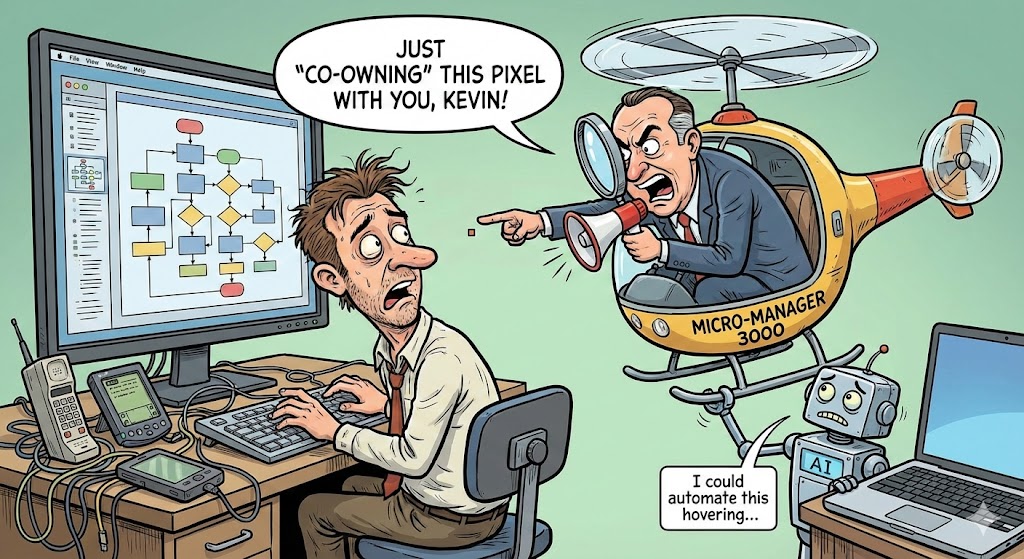
Inspired by: Shreyas Doshi’s Deep Dive on Micromanagement. Listen here before you rage-quit: Understanding Micromanagement: A Deep Dive
There is a moment in Shreyas Doshi’s brilliant analysis where he drops a truth bomb that usually sends “visionary” Product Managers scrambling for their noise-canceling headphones. He essentially argues that micromanagement is not a binary evil; it is a situational necessity.
To paraphrase one of his core insights: “High-performance execution often looks like micromanagement to low-performance employees.”
We treat micromanagement like it’s a contagious skin disease. But I’m here to tell you—as a seasoned Product Manager, entrepreneur, and engineer with 25+ years of scars—that most of the times you * do NOT need* a boss who breathes down your neck. But sometimes you do need one.
I have written code for Pocket PCs. I have built encryption systems for software and middleware for satellite PayTV systems (you know, those clunky boxes that enabled you to watch linear TV a decade ago—do they even still exist? Or are they just in a landfill somewhere wondering where the signal went?). I have ported WebKit browser engines into set-top boxes with 64MB of RAM and built Server-Side Ad Insertion (SSAI) for streaming.
I have seen the industry change from “How do we save a kilobyte?” to “Let’s just spin up another AWS instance.” And through it all, one truth remains: A fine balance is a myth. Execution is everything.
Sometimes, micromanagement is the only thing standing between a successful launch and a spectacular fireball. And sometimes, you have a boss who is just a control freak disguised as a “coach.” The trick is knowing the difference.
The Good Hover: The Day the Palm Pilot Died
Let’s rewind to 2001. “Cloud” meant rain was coming, “Agile” was a gymnastics term, and I was writing C code for the Palm Pilot.
For the uninitiated, the Palm Pilot ran on the DragonBall processor and had about as much memory as a modern refrigerator’s ice maker. If you messed up a pointer, you didn’t just get an error message; you got the “Fatal Exception” screen of death, and you had to find a paperclip to reset the device physically.
I was building a sync conduit—a piece of middleware supposed to talk to a desktop PC. It was crashing. Constantly.
My manager, let’s call him The Colonel, rolled his chair over.
Now, according to modern HR theory, this is an invasion of my “psychological safety.” According to Self-Determination Theory (SDT), humans crave autonomy, and The Colonel was threatening that. He didn’t ask me how I felt about the crash. He didn’t offer me a mental health day.
He said, “Open the memory handle lock. Show me the structure packing. Now.”
For four hours, he sat there. He watched me type. He pointed at the screen with a finger that smelled of cheap coffee. “You’re locking the memory chunk but not unlocking it before the serial port interrupt fires. You’re fragmenting the heap.”
I hated him. I felt suffocated. My Amygdala was firing off “fight or flight” signals because my ego was being crushed.
But here is the behavioral science twist: This was Task-Relevant Maturity (TRM) in action. As Andy Grove famously put it, when TRM is low (I was a junior idiot), the management style must be structured and hands-on.
We fixed the bug. The sync worked. The product shipped.
If The Colonel had “empowered” me to figure it out myself, we would have missed the launch, and I would have been fired. He didn’t micromanage me because he didn’t trust me as a person; he micromanaged the process because the cost of failure was absolute.
“My job is not to be easy on people. My job is to make them better." — Steve Jobs
The Bad Hover: The “Helicopter Founder” (A Horror Story)
Now, let’s flip the coin. Let’s talk about The Founder Who Can’t Let Go.
This is the dark side. I once worked for a Founder—let’s call him Steve-Not-Jobs.
Steve hired a team of senior engineers, ex-Google architects, and veteran PMs. We had 100 years of combined experience. We knew how to build scalable SaaS.
But Steve had what psychologists call the Illusion of Control. He believed that if he wasn’t in the room, the decision wouldn’t be made “correctly.”
- The Symptom: Steve would join every meeting. Even the stand-ups. Even the code reviews.
- The Excuse: “I just want to be hands-on! I’m a product-first CEO! I’m coaching you guys!”
- The Reality: He was treating highly capable experts like interns.
This triggers Learned Helplessness. When a team realizes their decisions will always be overturned by Steve, they stop making decisions. They stop innovating. They just wait for Steve to tell them what color the button should be.
I remember proposing a detailed architecture on how the system will work. Steve interrupted the meeting to argue about the font size on the login page for 45 minutes. He called it “attention to detail.” We called it “why are we here?”
This isn’t situational leadership. This is Narcissistic Supply. The founder uses the team as an audience to perform his own brilliance. He doesn’t want the product to succeed; he wants to be the reason the product succeeds.
“If you want to hire great people and have them stay working for you, you have to let them make a lot of decisions and you have to be run by ideas, not hierarchy." — Steve Jobs (ironically, the real one).
The HR Blind Spot: Why They Always (Okay! sometimes) Get It Wrong
Here is where the tragedy turns into comedy. Human Resources (HR) is statistically incapable of distinguishing between The Colonel (Good Micromanagement) and Steve-Not-Jobs (Bad Micromanagement).
Case A: The False Positive (Punishing the Good Manager)
I have seen HRBPs destroy great engineering cultures.
Let’s say I have a PM named Kevin (we all know a Kevin). Kevin loves strategy but hates execution. Kevin refuses to write detailed JIRA tickets because “that’s tactical.” When I start “micromanaging” Kevin—checking his work, demanding specs, sitting in his meetings to ensure he isn’t lying to customers—Kevin runs to HR.
Kevin: “I feel unheard. My manager is toxic.”
HR: “Oh no! We must protect psychological safety!”
HR applies the Fundamental Attribution Error. They assume I am a bad person (controlling) rather than looking at the situation (Kevin is incompetent). They put me on a Performance Improvement Plan for “leadership style,” while Kevin continues to produce slide decks that mean nothing.
Case B: The False Negative (Enabling the Bad Founder)
Conversely, HR often protects the Steve-Not-Jobs types.
When employees complain that Steve is suffocating them, HR frames it as: “He’s just so passionate! He’s a visionary! You need to learn to manage up!”
They mistake Neuroticism for Passion. They view his intrusion as “high engagement.”
This gaslights the employees into thinking they are the problem, leading to massive burnout and turnover.
“Success breeds complacency. Complacency breeds failure. Only the paranoid survive." — Andy Grove
The “Strategy-Only” PM: Every Team Has One
Let’s go deeper on Kevin.
Every organization has a “Strategy-Only” PM. This person believes they are the “CEO of the Product.” They want to set the vision, do the podcast circuit, and write “Thought Leadership” posts on LinkedIn.
But ask them to test the product on a staging server?
Kevin: “I’m really more about the why, not the how. I don’t want to get into the weeds.”
I have spent years fighting Kevins. The behavioral science here is the Dunning-Kruger Effect—a concept I explored in depth in my previous article on the Dunning-Kruger Effect: The Blind Spot of a Product Manager.
Kevin is so incompetent at execution that he literally cannot recognize how bad he is at it. He thinks “Strategy” is a separate output from “Execution.”
But as I learned building those satellite TV boxes: Strategy is just a hallucination until the encryption key validates.
When I force Kevin to do the grunt work, he experiences Cognitive Dissonance. He sees himself as a visionary; I treat him like a worker bee. To protect his ego, he labels me a “Micromanager.”
If you have a Kevin on your team, you must micromanage him. You have no choice. Because if you don’t, he will sell a vision to the stakeholders that your engineering team cannot build, and you will be the one left holding the bag when the deadline explodes.
“The smartest people are constantly revising their understanding, reconsidering a problem they thought they’d already solved. They’re open to new points of view, new information, new ideas, contradictions, and challenges to their own way of thinking." — Jeff Bezos
The AI Apocalypse: Judgment Day for the “Ideas Guy”
And now, the final boss: Artificial Intelligence.
If you thought micromanagement was a hot topic before, wait until AI really lands. The discourse is about to shift from “Who does the work?” to “Who verifies the truth?”
1. The Value Shift: From Creation to Judgment
We are entering an era where “creating” is free. You want code? Claude gives it to you. You want a PRD? ChatGPT writes it. You want a roadmap? Gemini sketches it.
This kills the “Idea Guy.” The only value left is Judgment and Execution.
- The Trap: AI is a confident liar. It will write a SQL query that looks perfect but deletes your production table. It will write a legal clause that sounds professional but violates GDPR.
- The New Skill: Can you smell the lie? Can you look at the code generated by the AI and know that it’s introducing a security vulnerability? Can you take the strategy the AI proposed and execute it against the messy reality of legacy systems?
If you cannot Judge the output and Execute the implementation, you are just a middleman between a hallucinating robot and a frustrated customer.
2. The Hallucinating Founder (Fintech Edition)
We are already seeing founders who use ChatGPT as their CTO.
- Founder: “I asked ChatGPT, and it said we can integrate with these three major banks and process a million micro-payments per second by next Friday.”
- Me: “The AI assumes banks use modern REST APIs. In reality, that bank runs on a mainframe from 1982 using COBOL and batch files that only update at midnight. The AI is hallucinating a world that doesn’t exist.”
This is the new danger. The founder micromanages the team based on a fantasy timeline created by an LLM that has never had to wait for a bank’s compliance department to approve a firewall rule.
3. AI as the “Positive Micromanager” (The New Hope)
However, there is a silver lining. AI enables “Async-Micromanagement”—the holy grail where rigor is enforced without the emotional toxicity of human hovering.
Here is how AI will positively transform the landscape:
- The Depersonalized “Bad Cop”
Normally, when I tell Kevin his PRD is vague, he takes it personally. But if I configure an AI Agent with strict rubrics (“Must contain error states,” “Must define API latency limits”), and Kevin submits his work to the AI first, the AI does the nitpicking.- The Result: The AI flags the missing edge cases. Kevin fixes them to get the “green light.” By the time the doc reaches me, it’s 90% solid. The AI did the micromanaging, and I get to be the strategist.
- The Result: The AI flags the missing edge cases. Kevin fixes them to get the “green light.” By the time the doc reaches me, it’s 90% solid. The AI did the micromanaging, and I get to be the strategist.
- The Socratic Simulator
Before a high-stakes review, I can tell my team: “Simulate the meeting with this specific AI Persona.”
They can upload their strategy to a GPT prompted to act like a cynical CTO. The AI will tear their logic apart, finding holes in their reasoning.- The Result: The team gets “micromanaged” in a safe sandbox. They fix their own gaps. When they present to me, they are bulletproof. This builds Task-Relevant Maturity faster than I ever could manually.
- The Result: The team gets “micromanaged” in a safe sandbox. They fix their own gaps. When they present to me, they are bulletproof. This builds Task-Relevant Maturity faster than I ever could manually.
- Observability vs. Surveillance
Micromanagement often stems from a lack of visibility. “What is Kevin doing?”
AI tools can now ingest Git commits, Jira updates, and Slack threads to generate a “Pulse Report”—not to spy, but to summarize progress.- The Result: Instead of tapping Kevin on the shoulder every 3 hours asking “Is it done?”, I look at the AI summary. I see the blockers. I see the velocity. I stay informed (micromanagement needs satisfied) without interrupting the workflow (autonomy preserved).
- The Result: Instead of tapping Kevin on the shoulder every 3 hours asking “Is it done?”, I look at the AI summary. I see the blockers. I see the velocity. I stay informed (micromanagement needs satisfied) without interrupting the workflow (autonomy preserved).
- The “Prompt-Based” Standard
Micromanagement is often just an attempt to enforce a standard of quality. With AI, you can encode that standard into a Prompt Library.- The Result: “Don’t just write a user story; use this prompt that forces you to consider the mobile constraints we discussed.” The prompt is the micromanager. It guides the execution path step-by-step, ensuring the output aligns with the vision, without me having to stand there reciting the rules.
“Artificial Intelligence is no match for Natural Stupidity. But together? They are unstoppable." — Tech Industry Proverb
Conclusion: Autonomy is Earned, Not Given
So, let’s wrap this up with a closure to our narrative.
Years after the Palm Pilot project, I ran into The Colonel at a conference. I bought him a beer.
“You were a nightmare,” I told him. “You hovered over me like a drone strike.”
He laughed. “And did the code crash?”
“No.”
“Did you learn how memory heaps work?”
“Yes.”
“Then I wasn’t micromanaging you,” he said. “I was teaching you how to survive.”
This is the message.
If you are a leader: Do not apologize for the hover. If the stakes are high and the person is unproven, get in the weeds. If they are a “Kevin,” manage them out or manage them up, but do not let them hide behind “strategy.”
If you are an employee: Stop whining about micromanagement and start shipping. The fastest way to get your boss off your back is to execute so flawlessly that they get bored watching you.
Autonomy is not a right found in the constitution. It is a reward for competence.
Now, if you’ll excuse me, I need to go micromanage my toaster. I don’t trust its “browning settings” one bit.
One Final Thought:“It is a grave error to think that delegation is the opposite of micromanagement. There is no way you can micromanage everything… but you must selectively micromanage the things that matter."
For more context on the leadership styles discussed here, specifically the nuances of “The Captain” vs “The General,” check out this discussion: Coaching Product Leadership with Shreyas Doshi: Part 2
This video is relevant as it features Shreyas discussing the different altitudes of leadership and how misapplying them leads to the “under-management” trap described above.